As technology evolves, global cargo continues to increase in volume, speed, and complexity. How will HS classification be handled in such an era?
In the past, HS classification “artisans” meticulously classified each item one by one, relying on WCO (World Customs Organization) rules, their deep knowledge, experience, and seasoned intuition. However, in today’s world, where an overwhelming amount of cargo moves rapidly across the globe with ever-growing complexity, manual HS classification by humans is becoming increasingly difficult.
Consequently, many have turned to using AI for classification. Below are the results of a LinkedIn poll I conducted.
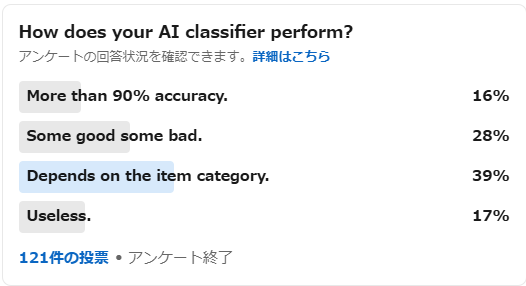
The following are the results of a poll conducted in 2023 titled, “How does your AI classifier perform?”
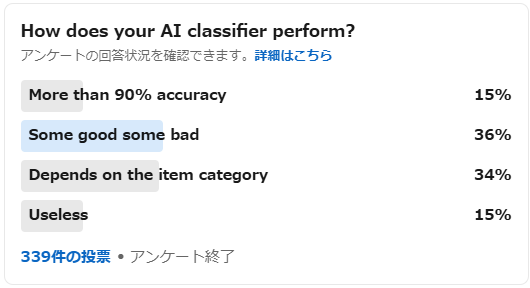
What was most surprising is that in a 2023 poll, 16% of people had a favorable opinion of AI’s judgment, stating it had “more than 90% accuracy.” However, this number decreased to 15% in 2025.
In just two years, AI as a whole has been evolving at a tremendous speed, and this remarkable development is astonishing to everyone. However, AI classifiers seem to be an exception, as an interesting phenomenon is occurring where the number of people who rate them highly is inversely proportional to the development of AI.
Furthermore, HS classification is a challenging task that requires decisions as close to 100% accurate as possible, while also addressing the issue of differing opinions that vary by country and customs officer.
However, in the polls, 70% of respondents answered that the AI only provides ambiguous conclusions such as “some good, some bad” or “depends on the item category.”
Isn’t this a fatal flaw in the work of HS classification? Additionally, with 15% responding that it is “useless,” a total of 85% of people believe that the answers from AI classifiers are not perfect.
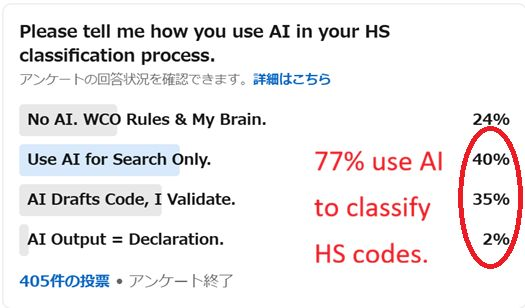
Next, I conducted a poll on LinkedIn titled, “Please tell me how you use AI in your HS classification process.” The results are as follows.
📊 The data reveals that 77% of respondents are using AI for HS classification in some capacity. (At the same time, I have the utmost respect for the 24% who continue to rely solely on their own deep knowledge and experience—true craftsmanship in our field.)
However, a very interesting “contradiction” emerges here.
In a previous poll asking about AI performance, the percentage of people who trusted AI’s judgment (stating it had “more than 90% accuracy”) actually dropped from 16% in 2023 to 15% in 2025.
In short: 📉 Trust in AI accuracy: Decreasing (2023 → 2025) 📈 AI usage rate: High at 77%
💡 The Reality on the Ground “We don’t fully trust it, but we use it anyway.” Isn’t this the current reality of HS classification?
As global trade volumes explode, the use of AI and technology is becoming indispensable. However, even if an AI achieves 95% accuracy, the remaining 5% of misclassifications can jeopardize a company’s entire compliance standing.
This is exactly why the value of human expertise—understanding WCO Rules, GRI, and Rulings—is actually increasing in the age of AI. We are the final line of defense.
AI is a powerful tool, but humans must remain at the wheel.
No matter how much technology evolves, the final decision-making must be done by human experts who cross-reference WCO rules and legal precedents.
The key to the future of HS classification lies in how effectively experts can collaborate with AI.
The real challenge, then, is determining how to effectively use AI to streamline the HS classification process. Those with only a superficial understanding of the subject tend to believe that “full automation via AI is possible,” but in reality, it is not that simple.
While it is true that AI can be helpful by providing correct HS codes for certain items, it frequently outputs incorrect codes the moment it encounters complex classification rules that it cannot fully grasp.
If a declarant submits a customs declaration without noticing these errors, they may suffer significant financial losses. Naturally, AI services always include disclaimers stating, “AI may make mistakes; please consult customs rulings for the correct HS code.”.
Therefore, when using AI for HS classification, it is impossible to even judge whether the AI’s answer is correct without a foundational knowledge of the classification rules.
Below are examples of why it is dangerous to let an AI perform HS classification when the user lacks the necessary knowledge.
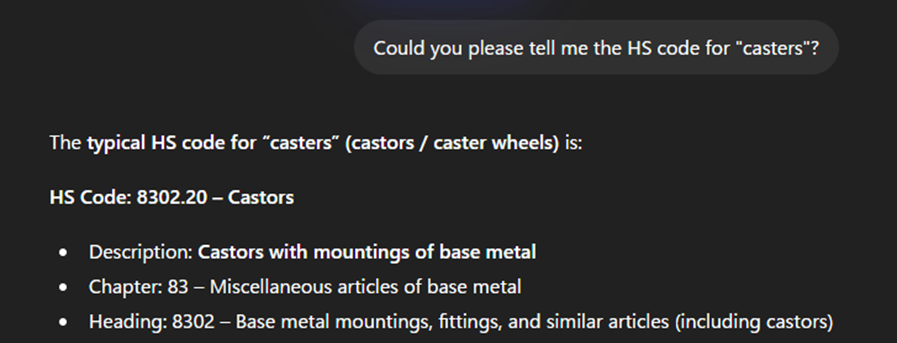
When classifying a standard caster with a ‘plastic wheel’ attached to a ‘steel mount,’ a quick keyword search for ‘caster’ will bring up its HS code directly. This might lead you to believe it’s an ‘easy item to classify.
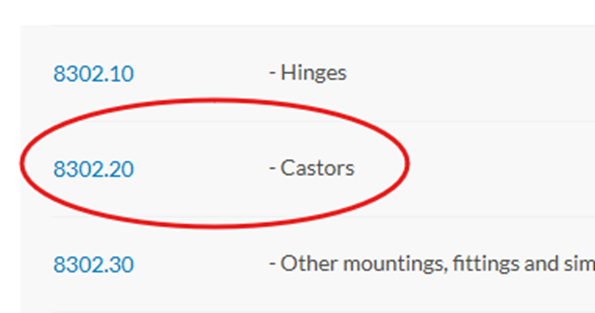
At first glance, the classification seems straightforward because the product name “Casters” is linked to HS code 8302.20, making it appear as though the task could be entirely outsourced to an AI.
However, there is a hidden pitfall here.
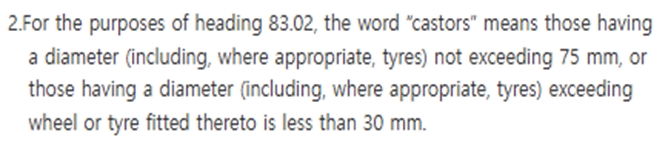
In the provisions of Note 2 to Chapter 83, there is a description written in small print that states the following:
Note 2 to Chapter 83
“Casters” classified under heading 83.02 are limited to those that meet either of the following conditions:
1.Those with a diameter (including tires) of 75 mm or less.
2.If the diameter exceeds 75 mm, the width of the wheel (including tires) must be less than 30 mm.
In other words, no matter how much the product in front of you functions or looks like a “caster,” and even if it is printed as a “caster” in the catalog, it will not be treated as a “caster of heading 83.02” under HS classification if it does not meet these dimensional specifications.
The moment it falls out of these requirements, you must restart the classification based on other criteria, such as the material (e.g., Chapter 39 if made of plastic, Chapter 73 if made of iron).
The cold hard fact shown by this example is that there is no value in simply “searching for a code based on a product name.”
True professional skill lies in “recognizing the moment you see the item name ‘caster’ that classification is impossible without data on the diameter and wheel width.”
The key is whether you can check with the shipper when you see an invoice or specification sheet lacking dimensional data, saying, “The information is insufficient. Please tell me the size.”
Beginners who do not know the regulations, or automation tools that make judgments based only on input text information, completely skip this process of “noticing missing information,” leading to incorrect declarations.
An Even Greater Barrier: Differing Interpretations of “Essential Character” Between Nations
If a product fails to meet the strict dimensional requirements mentioned earlier and is excluded from “Casters (8302),” the classification process becomes even more chaotic. What awaits next is the reality of “interpretational discrepancies between nations.”
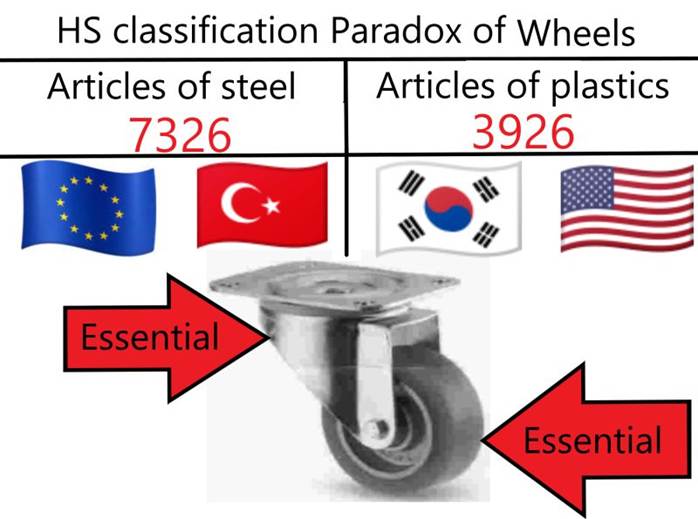
For example, let’s consider the classification of a general-purpose wheel consisting of a “steel mounting fixture” and a “plastic wheel.” If it does not meet the requirements for a caster, the classification is determined by judging whether the “essential character” of the product is steel or plastic (General Rule 3(b)).
However, there is no absolute “correct answer” as to what constitutes the “essential character,” and opinions are completely split depending on the country.
Even for a “wheel” that appears extremely simple and straightforward, the correct answer changes the moment it crosses a national border.
Countries that classify it as Steel (7326): EU DEBTI40177/21-1 and Eurodocument, Turkey :TR160000210032, etc. (Emphasis on the mounting fixture)
Countries that classify it as Plastic (3926): USA : NY 859395, South Korea :품목분류3과-6422, etc. (Emphasis on the wheel)
PHOTOVOLTAIC CELLS CASE
PHOTOVOLTAIC CELLS is A panel that converts sunlight into electricity.
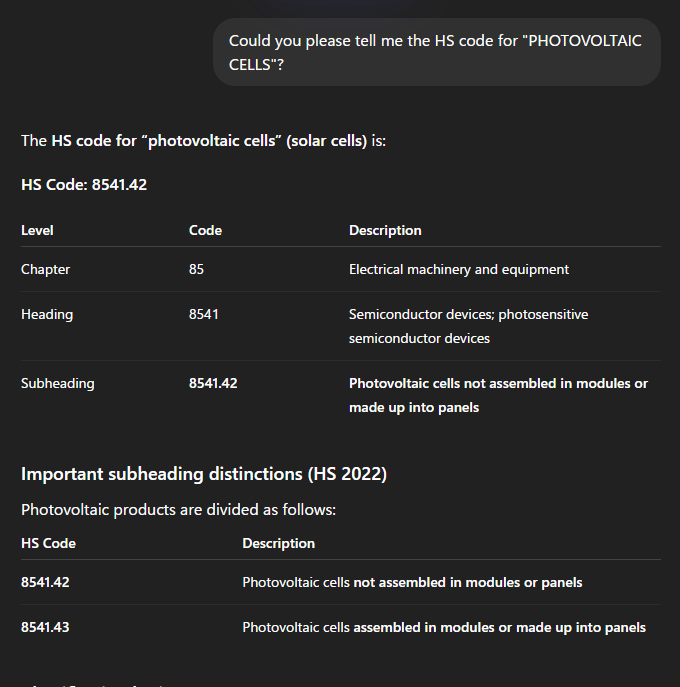
Hearing this function, both AI and beginners would likely attempt to classify it under heading 85.41 (Photovoltaic cells).
However, in the practice of HS classification, making a judgment based solely on the “primary function being the same” can cause fatal misdeclarations.
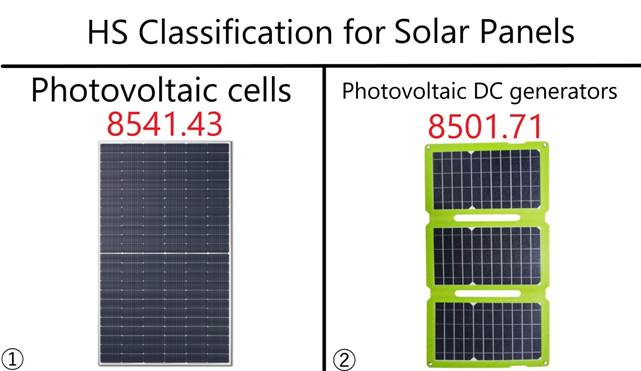
Let’s look at two cases (Photovoltaic cells cases) where items with nearly identical appearances and basic functions were classified under completely different HS codes.
■ Two “Photovoltaic Cells” That Are Alike Yet Different
Both of the following items are designed for the purpose of converting sunlight into electric power.
Item 1: Standard Photovoltaic Cells
Item 2: Photovoltaic Cells equipped with two USB charging ports
If you input “PHOTOVOLTAIC CELLS” into an AI or automated tool, it will likely return the same HS code. However, actual European Union Binding Tariff Information (BTI) clearly distinguishes them as follows:
■ Why Does a Simple “USB Port” Change the Classification?
Item 1 is purely for “converting sunlight into electricity.”
On the other hand, Item 2 does not just convert energy into DC current; it also possesses the additional function of “directly supplying appropriate power to specific devices” through its USB ports.
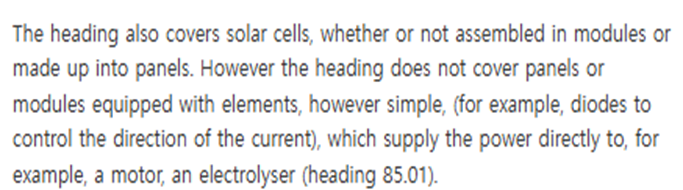
The basis for this difference is clearly stated in the Explanatory Notes to the HS (EN to 8541 (B)(2)(i)):
EN to 8541 (B)(2)(i)
In other words, a solar panel that can “directly supply power” to devices such as smartphones via a USB port or similar interface is no longer a mere “solar cell (85.41),” but is classified as a “generator (85.01).
If you wonder why, it becomes a generator, it is because the ability to control and adapt the current for an external device transforms it from a simple energy harvester into an active power supply.
■ The Expert’s Perspective: Assessing “How the Energy Is Used”
AI tends to rely on superficial word associations like “PHOTOVOLTAIC CELLS = 8541.” However, a human expert observes the product’s “exit strategy” (interface)—how the generated energy is ultimately utilized—and verifies if it triggers the exclusion provisions in the Explanatory Notes (EN).
Even an element “as simple as a USB port,” as long as it serves the purpose of supplying power to specific equipment, changes the legal status of the item from a mere photovoltaic cell to a “generator.”
This case illustrates how dangerous it is to rely on the intuition that “similar products belong in the same category” or on the “probabilistic answers” generated by AI.
ARTIFICIAL FLOWERS CASE
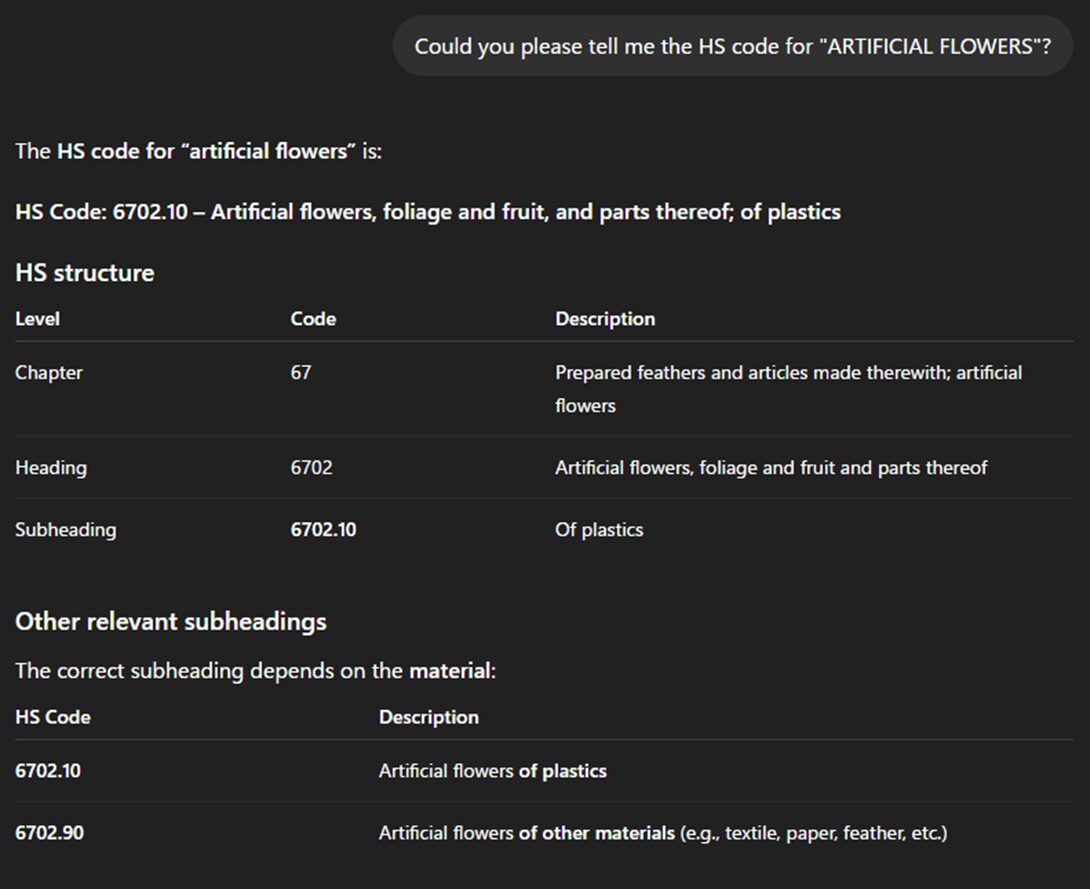
When classifying “ARTIFICIAL FLOWERS,” it appears as though searching by the product name will yield an immediate answer. If you let an AI or a similar tool handle the classification without careful thought, it will likely identify “ARTIFICIAL FLOWERS” under HS 6702 and conclude that this is a simple and correct solution.
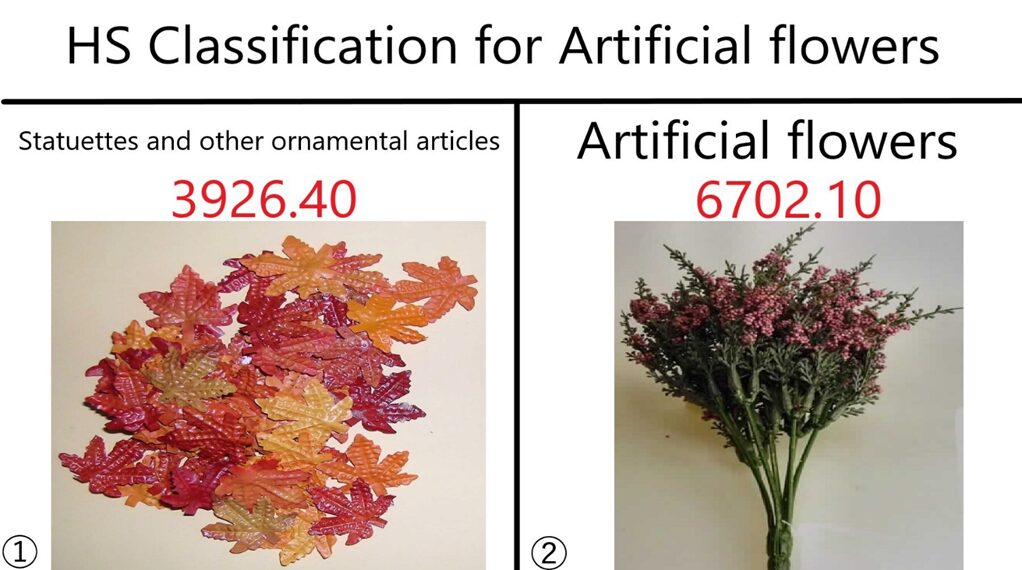
However, there is a hidden pitfall here as well. Consider two plastic artificial flowers that look and function identically. Despite their similarities, their HS classification can differ based on one factor: the “manufacturing process.”
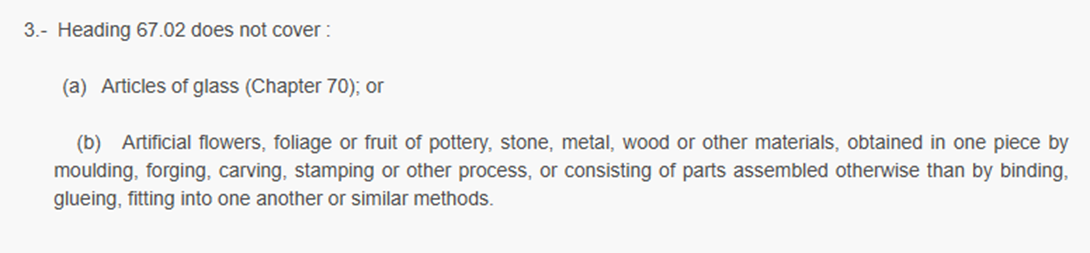
If the flower is made by assembling individual petals and stems, it is classified as “Artificial Flowers (6702).” However, if it is molded in one piece (integrated molding), it is excluded from that category by the legal notes (Chapter 67, Note 3(b)) and is classified instead as “Plastic Products (Chapter 39).”
CHAPTER 67, NOTE 3(B)
For an AI or a beginner who judges solely by “images” or “visual appearance,” the necessity of verifying the underlying manufacturing method would likely be completely unexpected.
HOURGLASS CASE
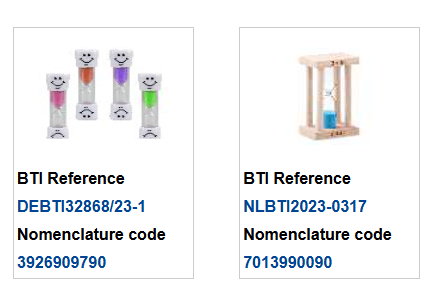
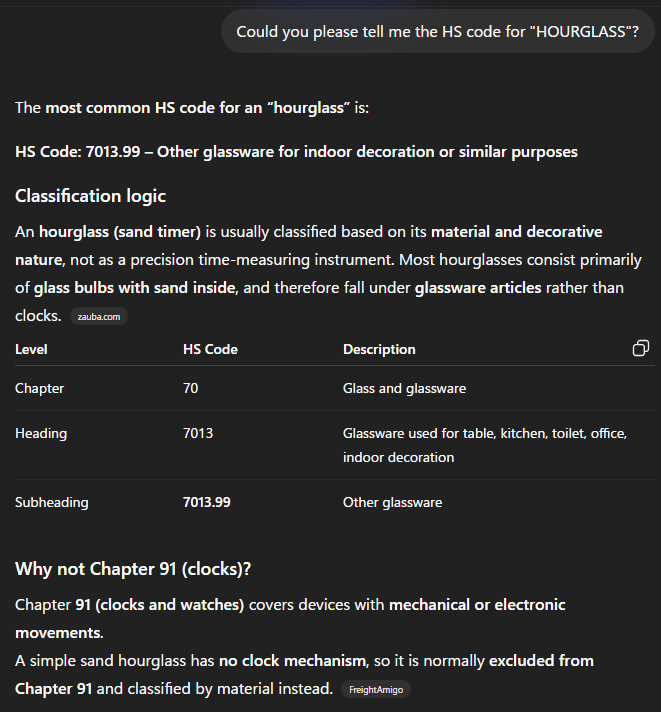
A typical hourglass is classified based on the material of its outer Vessel (e.g., 7013 for glass, 3926 for plastic). An AI would likely learn this pattern—”hourglass = material of the Vessel”—very quickly.
The General Explanatory Notes to Chapter 91 also provide the following provisions:
General Explanatory Notes to Chapter 91
Therefore, as shown in the following EU BTI, an hour glass is generally classified under heading 3926 or 7013, depending on the material of the vessel.
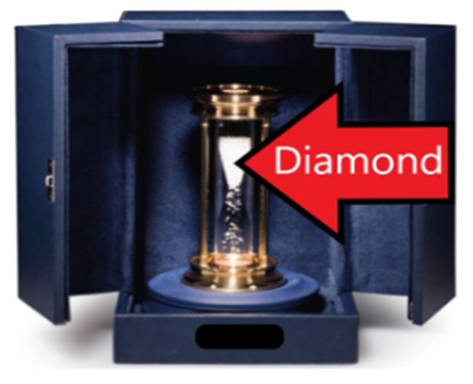
However, what if we have a luxury hourglass where the “sand” inside is actually diamonds?
Based on overwhelming historical probability data, an AI is likely to conclude that “since it is an hourglass, it should be classified by the material of its vessel,” incorrectly applying General Interpretative Rule 3(b) and treating it as a product of glass or plastic.
However, a human expert stops right there. This is because they are aware of the existence of the following powerful provision in the legal notes of Chapter 71 (Note 1 to Chapter 71):
Note 1 to Chapter 71
According to this provision, if diamonds (precious stones) are used in even a part of the product, it must be classified preferentially under Chapter 71 (such as 7116.20), regardless of the material of the container.
The True Value of an Expert: The Ability to Notice “Legal Exceptions”
Because if AI continues to focus on “past correct answers (Hourglass = Vessel),” it would overlook these decisive Legal Notes. On the other hand, an expert does not simply look at “how it was classified in the past.” Instead, they follow the General Rules for the Interpretation of the Harmonized System (GRI 1) and constantly verify whether any exception provisions are triggered by cross-referencing the current Legal Notes. In a U.S. Customs ruling (NY E89454), leading to its classification as “Articles of precious stones (7116).”
Tablet PC case
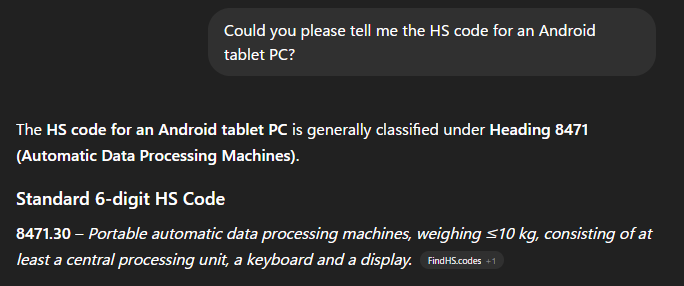
If it’s Windows or Android hardware with an Intel processor, camera, and touch panel, it should naturally fall under Heading 8471 (Automatic Data Processing Machines) of the Customs Tariff Schedule. If you are convinced of that, you need to be aware of dangerous HS classification edge cases.
Surprisingly, the following three “genuine tablet PCs” were all excluded from 8471 and classified under Heading 8537 (Boards/Panels for Electric Control).
📱 Edge Case 1: Smart Home Control Hub (GB123085989)(invalidated) Physically, it is a 7-inch Android tablet (built-in Wi-Fi, mic, camera). However, because the OS was customized (locked) to run a dedicated app for controlling home appliances and lighting—preventing the free use of other general-purpose apps—it was classified under 8537.
💻 Edge Case 2: Panel PC for Temperature Validation Systems (DE13327/15-1)(invalidated) A 10.4-inch “Windows Tablet PC (1.5kg)” equipped with an Intel processor, Windows OS, and even a fingerprint reader. However, because it was imported as the primary dedicated control panel (interface) for a temperature management system, it was classified under 8537.
🖥 Edge Case 3: Dedicated Video Conferencing Controller (DEBTI40838/23-1) A tablet enclosure with an 8-inch capacitive touchscreen and a stand. It was imported as a tabletop panel to control the video and communication of an entire conferencing system, and was likewise classified under 8537.
⚖️ Why is a “Tablet” not always an “ADP Machine”? (Legal Grounds)
The exclusion of these products from Heading 8471 typically stems from two critical legal hurdles in Chapter 84:
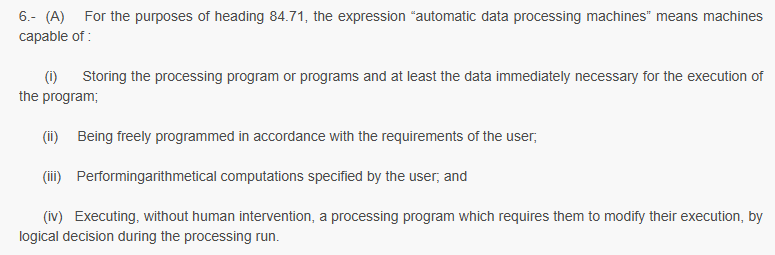
1. The “Freely Programmable” Requirement (Note 6(A)(ii)) Before looking at the function, a device must first meet the definition of an Automatic Data Processing (ADP) machine. Under Note 6(A)(ii), a machine must be “freely programmable” in accordance with the requirements of the user. If the OS is locked or the hardware is restricted to a specific application, it fails this primary test and is immediately disqualified from 8471.
Note 6(A)(ii) to Chapter 84
2. The “Specific Function” Rule (Note 6(E)) Even if a device is high-performance and technically capable of being programmed, Note 6(E) provides a powerful exclusion:
Note 6(E) to Chapter 84
In short, if the device’s essence is to perform a specific task—such as controlling a smart home, managing temperature, or presiding over a conference system—it is classified by that function (e.g., Heading 8537) rather than as a general-purpose PC.
In other words, no matter how high-performance the hardware (internal components) is, if it is combined with a “specific function (use)”—such as the electrical control of a smart home, temperature system, or conferencing system—and that function constitutes the essence of the product, Customs will not recognize it as a “general-purpose PC.”
🚨 Surge in Classification Errors and Penalty Risks in the IoT Era Today, many home appliances and industrial machines are becoming IoT-enabled, with “tablet UIs” being integrated and imported as control panels.





Leave a Reply