As technology evolves, global cargo continues to increase in volume, speed, and complexity. How will HS classification be handled in such an era?
In the past, HS classification “artisans” meticulously classified each item one by one, relying on WCO (World Customs Organization) rules, their deep knowledge, experience, and seasoned intuition. However, in today’s world, where an overwhelming amount of cargo moves rapidly across the globe with ever-growing complexity, manual HS classification by humans is becoming increasingly difficult.
Consequently, many have turned to using AI for classification. Below are the results of a LinkedIn poll I conducted.
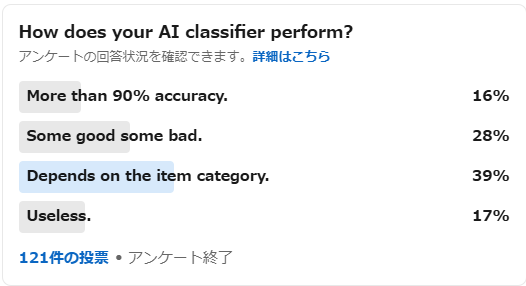
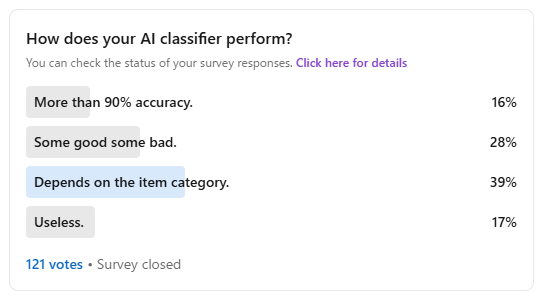
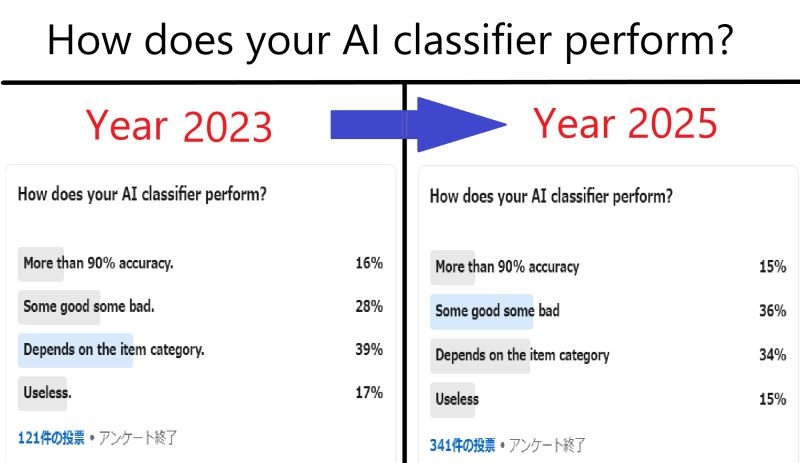
The following are the results of a poll conducted in 2023 titled, “How does your AI classifier perform?”
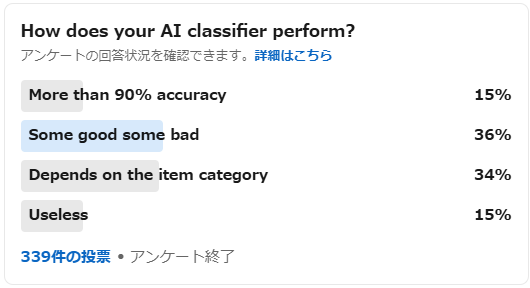
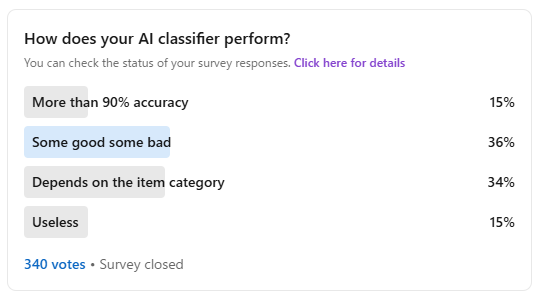
What was most surprising is that in a 2023 poll, 16% of people had a favorable opinion of AI’s judgment, stating it had “more than 90% accuracy.” However, this number decreased to 15% in 2025.
In just two years, AI as a whole has been evolving at a tremendous speed, and this remarkable development is astonishing to everyone. However, AI classifiers seem to be an exception, as an interesting phenomenon is occurring where the number of people who rate them highly is inversely proportional to the development of AI.
Furthermore, HS classification is a challenging task that requires decisions as close to 100% accurate as possible, while also addressing the issue of differing opinions that vary by country and customs officer.
However, in the polls, 70% of respondents answered that the AI only provides ambiguous conclusions such as “some good, some bad” or “depends on the item category.”
Isn’t this a fatal flaw in the work of HS classification? Additionally, with 15% responding that it is “useless,” a total of 85% of people believe that the answers from AI classifiers are not perfect.
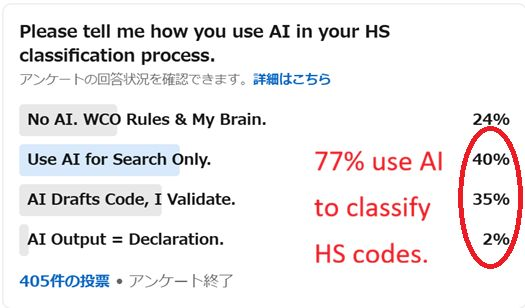
Next, I conducted a poll on LinkedIn titled, “Please tell me how you use AI in your HS classification process.” The results are as follows.
📊 The data reveals that 77% of respondents are using AI for HS classification in some capacity. (At the same time, I have the utmost respect for the 24% who continue to rely solely on their own deep knowledge and experience—true craftsmanship in our field.)
However, a very interesting “contradiction” emerges here.
In a previous poll asking about AI performance, the percentage of people who trusted AI’s judgment (stating it had “more than 90% accuracy”) actually dropped from 16% in 2023 to 15% in 2025.
In short: 📉 Trust in AI accuracy: Decreasing (2023 → 2025) 📈 AI usage rate: High at 77%
💡 The Reality on the Ground “We don’t fully trust it, but we use it anyway.” Isn’t this the current reality of HS classification?
As global trade volumes explode, the use of AI and technology is becoming indispensable. However, even if an AI achieves 95% accuracy, the remaining 5% of misclassifications can jeopardize a company’s entire compliance standing.
This is exactly why the value of human expertise—understanding WCO Rules, GRI, and Rulings—is actually increasing in the age of AI. We are the final line of defense.
AI is a powerful tool, but humans must remain at the wheel.
No matter how much technology evolves, the final decision-making must be done by human experts who cross-reference WCO rules and legal precedents.
The key to the future of HS classification lies in how effectively experts can collaborate with AI.
The real challenge, then, is determining how to effectively use AI to streamline the HS classification process. Those with only a superficial understanding of the subject tend to believe that “full automation via AI is possible,” but in reality, it is not that simple.
While it is true that AI can be helpful by providing correct HS codes for certain items, it frequently outputs incorrect codes the moment it encounters complex classification rules that it cannot fully grasp.
If a declarant submits a customs declaration without noticing these errors, they may suffer significant financial losses. Naturally, AI services always include disclaimers stating, “AI may make mistakes; please consult customs rulings for the correct HS code.”.
Therefore, when using AI for HS classification, it is impossible to even judge whether the AI’s answer is correct without a foundational knowledge of the classification rules.
Below are examples of why it is dangerous to let an AI perform HS classification when the user lacks the necessary knowledge.
CASTORS CASE
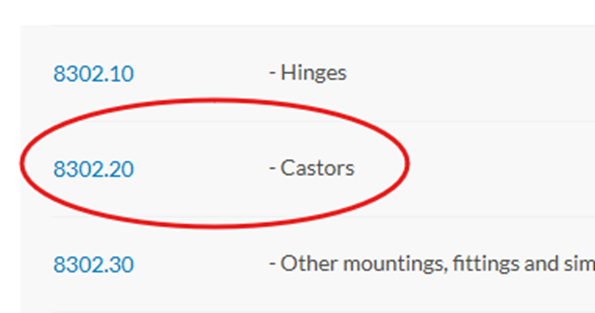
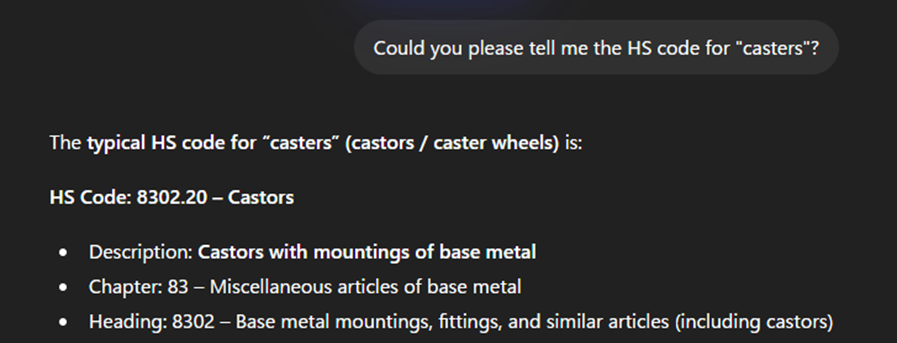
When classifying a standard caster with a ‘plastic wheel’ attached to a ‘steel mount,’ a quick keyword search for ‘caster’ will bring up its HS code directly. This might lead you to believe it’s an ‘easy item to classify.
At first glance, the classification seems straightforward because the product name “Casters” is linked to HS code 8302.20, making it appear as though the task could be entirely outsourced to an AI.
However, there is a hidden pitfall here.
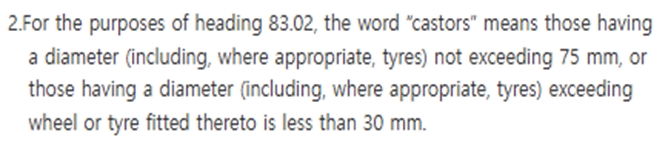
In the provisions of Note 2 to Chapter 83, there is a description written in small print that states the following:
Note 2 to Chapter 83
“Casters” classified under heading 83.02 are limited to those that meet either of the following conditions:
1.Those with a diameter (including tires) of 75 mm or less.
2.If the diameter exceeds 75 mm, the width of the wheel (including tires) must be less than 30 mm.
In other words, no matter how much the product in front of you functions or looks like a “caster,” and even if it is printed as a “caster” in the catalog, it will not be treated as a “caster of heading 83.02” under HS classification if it does not meet these dimensional specifications.
The moment it falls out of these requirements, you must restart the classification based on other criteria, such as the material (e.g., Chapter 39 if made of plastic, Chapter 73 if made of iron).
The cold hard fact shown by this example is that there is no value in simply “searching for a code based on a product name.”
True professional skill lies in “recognizing the moment you see the item name ‘caster’ that classification is impossible without data on the diameter and wheel width.”
The key is whether you can check with the shipper when you see an invoice or specification sheet lacking dimensional data, saying, “The information is insufficient. Please tell me the size.”
Beginners who do not know the regulations, or automation tools that make judgments based only on input text information, completely skip this process of “noticing missing information,” leading to incorrect declarations.
An Even Greater Barrier: Differing Interpretations of “Essential Character” Between Nations
If a product fails to meet the strict dimensional requirements mentioned earlier and is excluded from “Casters (8302),” the classification process becomes even more chaotic. What awaits next is the reality of “interpretational discrepancies between nations.”
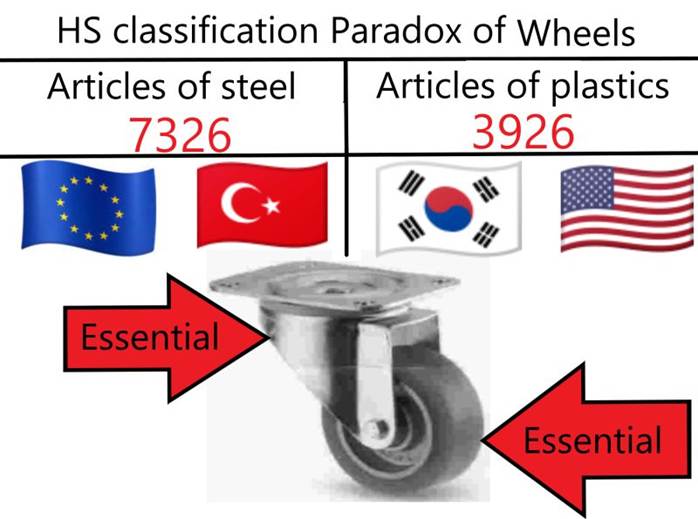
For example, let’s consider the classification of a general-purpose wheel consisting of a “steel mounting fixture” and a “plastic wheel.” If it does not meet the requirements for a caster, the classification is determined by judging whether the “essential character” of the product is steel or plastic (General Rule 3(b)).
However, there is no absolute “correct answer” as to what constitutes the “essential character,” and opinions are completely split depending on the country.
Even for a “wheel” that appears extremely simple and straightforward, the correct answer changes the moment it crosses a national border.
Countries that classify it as Steel (7326): EU DEBTI40177/21-1 and Eurodocument, Turkey :TR160000210032, etc. (Emphasis on the mounting fixture)
Countries that classify it as Plastic (3926): USA : NY 859395, South Korea :품목분류3과-6422, etc. (Emphasis on the wheel)
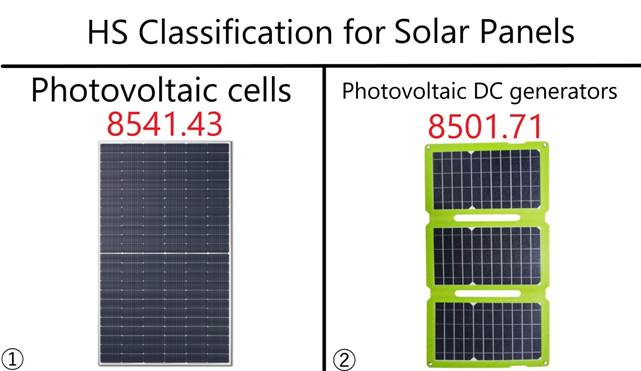
PHOTOVOLTAIC CELLS CASE
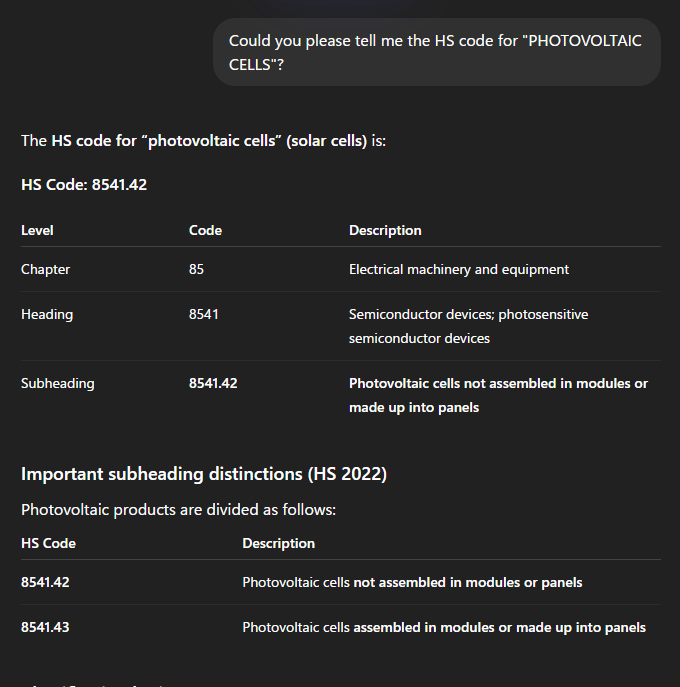
PHOTOVOLTAIC CELLS is A panel that converts sunlight into electricity.
Hearing this function, both AI and beginners would likely attempt to classify it under heading 85.41 (Photovoltaic cells).
However, in the practice of HS classification, making a judgment based solely on the “primary function being the same” can cause fatal misdeclarations.
Let’s look at two cases (Photovoltaic cells cases) where items with nearly identical appearances and basic functions were classified under completely different HS codes.
■ Two “Photovoltaic Cells” That Are Alike Yet Different
Both of the following items are designed for the purpose of converting sunlight into electric power.
Item 1: Standard Photovoltaic Cells
Item 2: Photovoltaic Cells equipped with two USB charging ports
If you input “PHOTOVOLTAIC CELLS” into an AI or automated tool, it will likely return the same HS code. However, actual European Union Binding Tariff Information (BTI) clearly distinguishes them as follows:
■ Why Does a Simple “USB Port” Change the Classification?
Item 1 is purely for “converting sunlight into electricity.”
On the other hand, Item 2 does not just convert energy into DC current; it also possesses the additional function of “directly supplying appropriate power to specific devices” through its USB ports.
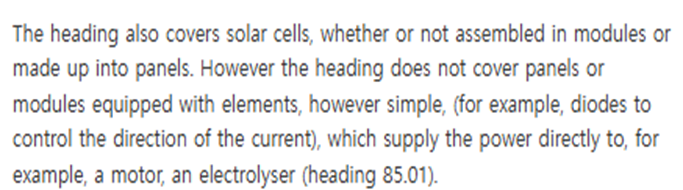
The basis for this difference is clearly stated in the Explanatory Notes to the HS (EN to 8541 (B)(2)(i)):
EN to 8541 (B)(2)(i)
In other words, a solar panel that can “directly supply power” to devices such as smartphones via a USB port or similar interface is no longer a mere “solar cell (85.41),” but is classified as a “generator (85.01).
If you wonder why, it becomes a generator, it is because the ability to control and adapt the current for an external device transforms it from a simple energy harvester into an active power supply.
■ The Expert’s Perspective: Assessing “How the Energy Is Used”
AI tends to rely on superficial word associations like “PHOTOVOLTAIC CELLS = 8541.” However, a human expert observes the product’s “exit strategy” (interface)—how the generated energy is ultimately utilized—and verifies if it triggers the exclusion provisions in the Explanatory Notes (EN).
Even an element “as simple as a USB port,” as long as it serves the purpose of supplying power to specific equipment, changes the legal status of the item from a mere photovoltaic cell to a “generator.”
This case illustrates how dangerous it is to rely on the intuition that “similar products belong in the same category” or on the “probabilistic answers” generated by AI.
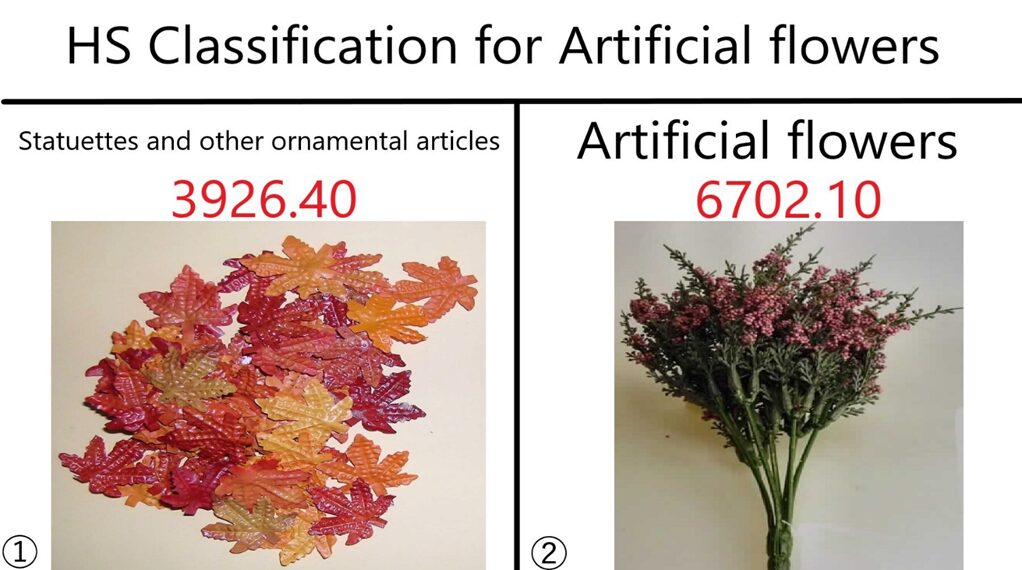
ARTIFICIAL FLOWERS CASE
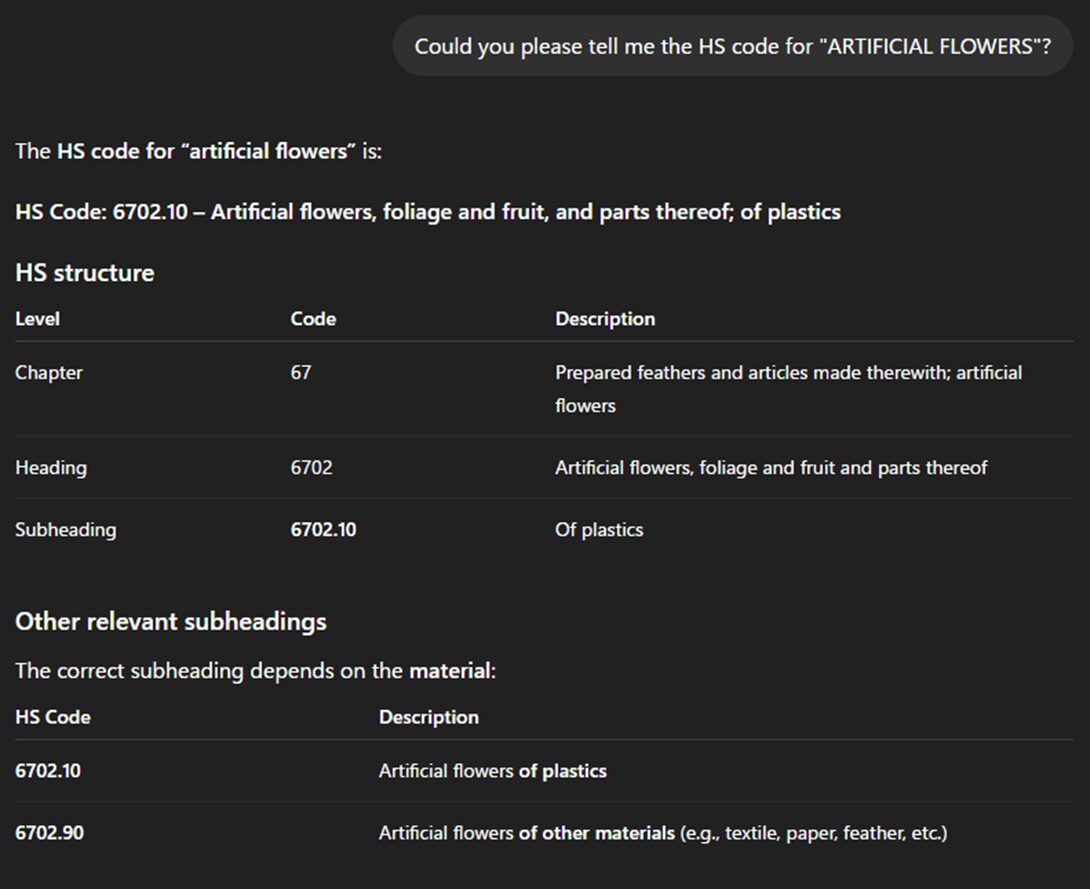
When classifying “ARTIFICIAL FLOWERS,” it appears as though searching by the product name will yield an immediate answer. If you let an AI or a similar tool handle the classification without careful thought, it will likely identify “ARTIFICIAL FLOWERS” under HS 6702 and conclude that this is a simple and correct solution.
However, there is a hidden pitfall here as well. Consider two plastic artificial flowers that look and function identically. Despite their similarities, their HS classification can differ based on one factor: the “manufacturing process.”
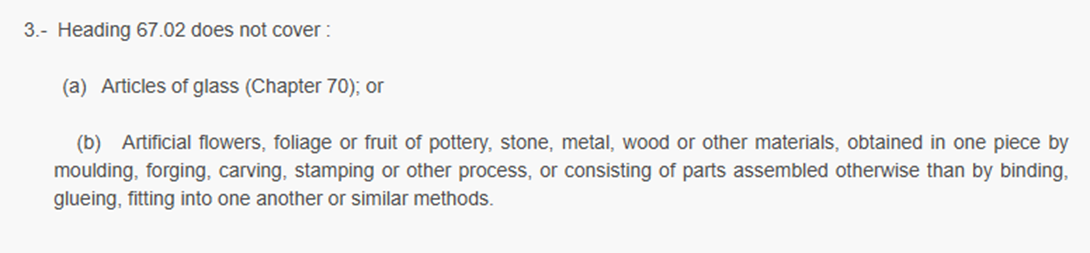
If the flower is made by assembling individual petals and stems, it is classified as “Artificial Flowers (6702).” However, if it is molded in one piece (integrated molding), it is excluded from that category by the legal notes (Chapter 67, Note 3(b)) and is classified instead as “Plastic Products (Chapter 39).”
CHAPTER 67, NOTE 3(B)
For an AI or a beginner who judges solely by “images” or “visual appearance,” the necessity of verifying the underlying manufacturing method would likely be completely unexpected.
HOURGLASS CASE
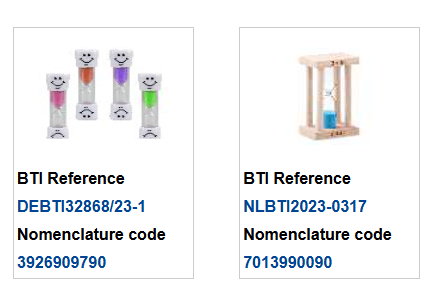
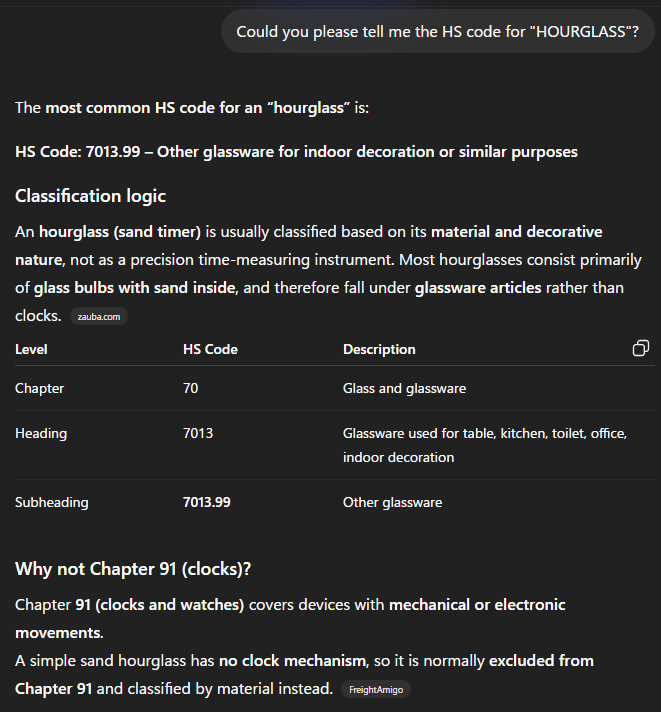
A typical hourglass is classified based on the material of its outer Vessel (e.g., 7013 for glass, 3926 for plastic). An AI would likely learn this pattern—”hourglass = material of the Vessel”—very quickly.
The General Explanatory Notes to Chapter 91 also provide the following provisions:
General Explanatory Notes to Chapter 91
Therefore, as shown in the following EU BTI, an hour glass is generally classified under heading 3926 or 7013, depending on the material of the vessel.
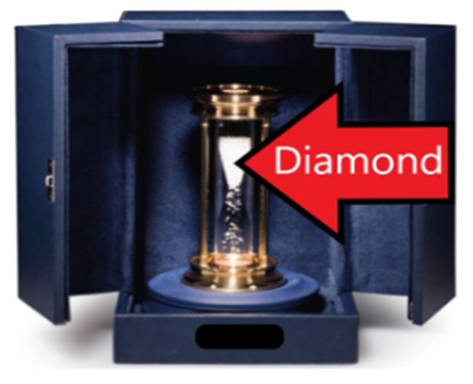
However, what if we have a luxury hourglass where the “sand” inside is actually diamonds?
Based on overwhelming historical probability data, an AI is likely to conclude that “since it is an hourglass, it should be classified by the material of its vessel,” incorrectly applying General Interpretative Rule 3(b) and treating it as a product of glass or plastic.
However, a human expert stops right there. This is because they are aware of the existence of the following powerful provision in the legal notes of Chapter 71 (Note 1 to Chapter 71):
Note 1 to Chapter 71
According to this provision, if diamonds (precious stones) are used in even a part of the product, it must be classified preferentially under Chapter 71 (such as 7116.20), regardless of the material of the container.
The True Value of an Expert: The Ability to Notice “Legal Exceptions”
Because if AI continues to focus on “past correct answers (Hourglass = Vessel),” it would overlook these decisive Legal Notes. On the other hand, an expert does not simply look at “how it was classified in the past.” Instead, they follow the General Rules for the Interpretation of the Harmonized System (GRI 1) and constantly verify whether any exception provisions are triggered by cross-referencing the current Legal Notes. In a U.S. Customs ruling (NY E89454), leading to its classification as “Articles of precious stones (7116).”
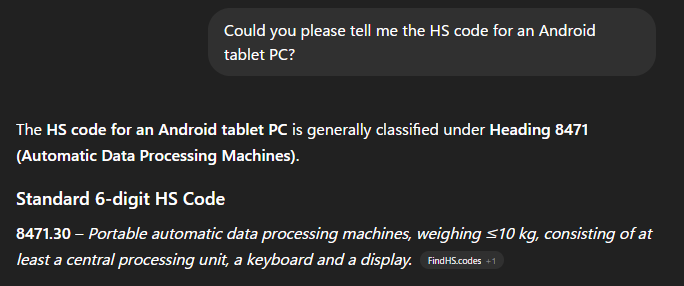
Tablet PC case
If it’s Windows or Android hardware with an Intel processor, camera, and touch panel, it should naturally fall under Heading 8471 (Automatic Data Processing Machines) of the Customs Tariff Schedule. If you are convinced of that, you need to be aware of dangerous HS classification edge cases.
Surprisingly, the following three “genuine tablet PCs” were all excluded from 8471 and classified under Heading 8537 (Boards/Panels for Electric Control).
📱 Edge Case 1: Smart Home Control Hub (GB123085989)(invalidated) Physically, it is a 7-inch Android tablet (built-in Wi-Fi, mic, camera). However, because the OS was customized (locked) to run a dedicated app for controlling home appliances and lighting—preventing the free use of other general-purpose apps—it was classified under 8537.
💻 Edge Case 2: Panel PC for Temperature Validation Systems (DE13327/15-1)(invalidated) A 10.4-inch “Windows Tablet PC (1.5kg)” equipped with an Intel processor, Windows OS, and even a fingerprint reader. However, because it was imported as the primary dedicated control panel (interface) for a temperature management system, it was classified under 8537.
🖥 Edge Case 3: Dedicated Video Conferencing Controller (DEBTI40838/23-1) A tablet enclosure with an 8-inch capacitive touchscreen and a stand. It was imported as a tabletop panel to control the video and communication of an entire conferencing system, and was likewise classified under 8537.
⚖️ Why is a “Tablet” not always an “ADP Machine”? (Legal Grounds)
The exclusion of these products from Heading 8471 typically stems from two critical legal hurdles in Chapter 84:
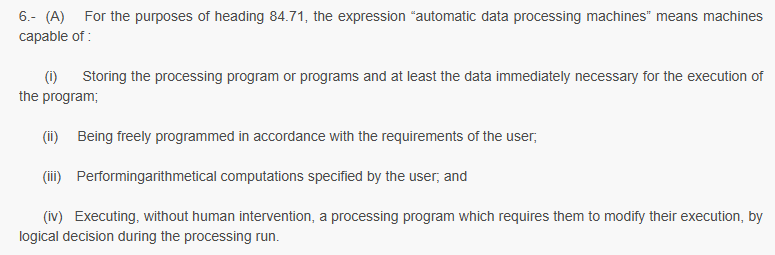
1. The “Freely Programmable” Requirement (Note 6(A)(ii)) Before looking at the function, a device must first meet the definition of an Automatic Data Processing (ADP) machine. Under Note 6(A)(ii), a machine must be “freely programmable” in accordance with the requirements of the user. If the OS is locked or the hardware is restricted to a specific application, it fails this primary test and is immediately disqualified from 8471.
Note 6(A)(ii) to Chapter 84
2. The “Specific Function” Rule (Note 6(E)) Even if a device is high-performance and technically capable of being programmed, Note 6(E) provides a powerful exclusion:
Note 6(E) to Chapter 84
In short, if the device’s essence is to perform a specific task—such as controlling a smart home, managing temperature, or presiding over a conference system—it is classified by that function (e.g., Heading 8537) rather than as a general-purpose PC.
In other words, no matter how high-performance the hardware (internal components) is, if it is combined with a “specific function (use)”—such as the electrical control of a smart home, temperature system, or conferencing system—and that function constitutes the essence of the product, Customs will not recognize it as a “general-purpose PC.”
🚨 Surge in Classification Errors and Penalty Risks in the IoT Era Today, many home appliances and industrial machines are becoming IoT-enabled, with “tablet UIs” being integrated and imported as control panels.
In the world of international trade, determining the correct HS (Harmonized System) code is often seen as a technical hurdle. However, beneath the surface, it is a rigorous legal exercise. As AI tools become more prevalent in customs offices, a dangerous gap is widening between how machines “think” and how the law actually operates.
The Deterministic Process of GIRs
Actual customs practice is a deterministic process governed by the General Interpretative Rules (GIRs). These six legal principles ensure that for any given product, there is only one legally correct classification.
The process must always begin with GIR 1, which states that classification is determined by the terms of the headings and any relative Section or Chapter Notes.
The Power of Legal Notes
The “Legal Notes” found at the beginning of HS Sections and Chapters are not merely suggestions—they are legally binding. They contain complex Exclusions and Priority Rules that can override physical appearance:
Exclusions: A product may look like a “plastic container,” but if a Chapter Note states, “This chapter does not cover specific containers for X,” it must be classified elsewhere, regardless of its material.
Priority Rules: Notes like Chapter 29, Note 3, dictate that if a product could fall under two headings, it must be classified in the heading that occurs last in numerical order.
The “Lack of Legal Reasoning” Trap in AI
Current AI models, specifically those using neural networks, struggle with the deductive logic required to navigate these rules. In a vector space where AI calculates “text similarity,” the phrases “Including A” and “Excluding A” are mathematically very close because they share almost all the same words.
However, in a legal context, those two phrases lead to diametrically opposed outcomes. While AI can learn the frequency of words, it cannot logically process a “Legal Exclusion” or a “Hierarchical Priority” based on the GIRs.
Comparison: Machine Learning vs. Legal Classification
Feature
ML-Based AI Tools (Stochastic)
Legal HS Classification (Deterministic)
Foundation of Inference
Statistical patterns and text similarity in datasets.
GIRs and Section/Chapter Legal Notes.
Nature of Output
Probabilistic guess (e.g., “95% certain”).
The single legally correct answer (100% binding).
Handling Exceptions
Weak at “edge cases” or complex exclusions not frequent in data.
Mandatory application of strict exclusionary rules.
Process Transparency
Black Box: Difficult to verbalize the legal rationale.
Transparent: Can cite the exact GIR or Note used for the decision.
The Danger of Overconfidence: The “Confidence Level” Illusion
One of the most significant risks highlighted in WCO (World Customs Organization) reports is the misunderstanding of “Confidence Levels.”
A machine learning model might assign a 95.76% confidence score to a classification that is legally incorrect. For example, errors have been reported in the classification of automotive engine mounts where AI provided high confidence for the wrong code.
Crucial Distinction: This percentage does not mean there is a 95% chance the code is legally correct. It simply means the code aligns closely with the AI’s internal statistical patterns.
When importers or brokers see a high percentage, they often mistake it for a legal guarantee. This leads to “automation bias,” where users stop questioning the output, eventually leading to misdeclaration, fines, and compliance audits.
A surprising result emerged when we solicited opinions from many people who have used AI classifiers.
What was most surprising is that in a 2023 poll, 16% of people had a favorable opinion of AI’s judgment, stating it had “more than 90% accuracy.”
However, this number decreased to 15% in 2025.
In just two years, AI as a whole has been evolving at a tremendous speed, and this remarkable development is astonishing to everyone. However, AI classifiers seem to be an exception, as an interesting phenomenon is occurring where the number of people who rate them highly is inversely proportional to the development of AI.
Furthermore, HS classification is a challenging task that requires decisions as close to 100% accurate as possible, while also addressing the issue of differing opinions that vary by country and customs officer.
However, in the polls, 70% of respondents answered that the AI only provides ambiguous conclusions such as “some good, some bad” or “depends on the item category.”
Isn’t this a fatal flaw in the work of HS classification? Additionally, with 15% responding that it is “useless,” a total of 85% of people believe that the answers from AI classifiers are not perfect.
From this, we can understand the following two points:
1. I do not intend to completely negate AI classifiers, because they may have excellent aspects as a co-pilot. However, at present, they can only serve in a supplementary role. It is a terribly dangerous act to declare the decisions of an AI classifier to customs without any knowledge or questioning of the output.
2. HS classification by human experts is an essential skill, knowledge, and experience that will continue to be needed for a long time to come. No matter how much AI evolves in the future, the final judgment by expert personnel is essential.
Rather than viewing AI with anxiety about white-collar jobs being replaced, we urge professionals to recognize the enduring value of their role in HS classification.
Your expertise is more crucial than ever and will continue to be in high demand.
Continue to fulfill your duties with pride, knowing you are an essential expert in the future of the trade industry.
On December 18, 2018, a notice arrived at the headquarters of M/s Secure Meters Ltd., a leading smart meter manufacturer in India. The sender was the Directorate of Revenue Intelligence (DRI), the investigative arm of India’s Ministry of Finance. The contents were difficult to believe.
“There is an error in the tariff classification of the electronic components you have imported. You are ordered to pay a supplementary duty of ₹458,388,872 (approx. $5.5 million USD) and a penalty of the same amount.”
The total demand was nearly $11 million. It was a nightmarish proclamation that threatened the very existence of the company.
The root of it all was a single difference of opinion over the interpretation of the HS code for a tiny electronic component, small enough to fit on a fingertip: the “communication module.” And this was despite the fact that Secure Meters had been importing this component since 2017, had sincerely explained their reasoning when questioned by a customs officer at the time, and had their classification accepted.
This is the record of a dramatic legal battle where the fate of a company and the principles of justice in international trade were put to the test.
Chapter 1: The Castle of the Future and a Single Lego Block
The stage for this story is the “smart meter,” an indispensable piece of modern infrastructure.
If the old electricity meters were like a “film camera” that only a meter reader could check once a month, the smart meter is a “modern smartphone.”
It measures electricity consumption every 30 minutes and automatically transmits the data to the power company. It is the completed “castle” that supports the future of our power grid.
So, what was the “communication module” that became the flashpoint for a $11 million dispute?
It is the heart that supports the “intelligence” of the smart meter. It’s an electronic circuit board equivalent to the “SIM card” or “Wi-Fi chip” in a smartphone. Without it, a smart meter is just a box that displays numbers.
What Secure Meters imported was not the finished smart meter (the castle).
It was just a single component for building the castle: a “Lego block.”
Chapter 2: The Two Numbers That Decided a Fate – The Courtroom Showdown
In court, the arguments of the two sides were in direct opposition. The core of the dispute is summarized in the table below:
Point of Contention
Argument of Customs (Prosecution)
Argument of Secure Meters (Defense)
Claim
“This component’s only destiny is to be part of a meter. Therefore, it is a ‘child part’ of the meter.”
“The law requires that goods be classified ‘as they are’ at the moment of importation.”
HS Code
9028 (Parts for electricity meters, etc.)
8517 (Parts for telecommunication apparatus)
Tariff Rate
20%
0% (Eligible for exemption notification)
Result
Back-duties and penalty of approx. $5.5 million each
No additional duty payable
The first-instance judgment (Order-in-Original) issued by the Principal Commissioner fully supported the customs’ claim. Secure Meters was pushed into a desperate corner.
Chapter 3: The Gavel of Justice and the “Lego Block Principle”
The stage moved to the appellate court, the Customs, Excise & Service Tax Appellate Tribunal. The verdict handed down was a complete victory for Secure Meters.
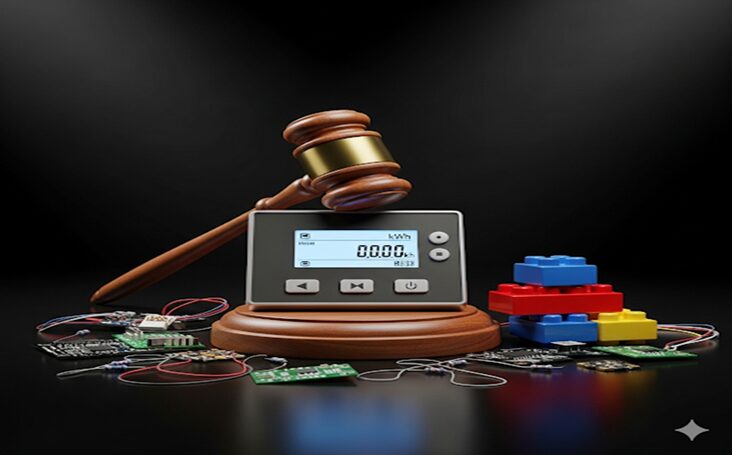
Underpinning the decision was an absolute rule in import classification, a legal basis we should call the “Lego Block Principle.”
Legal Basis 1: The Ironclad Rule of Customs Law – The “Lego Block Principle”
The tribunal declared unequivocally:
“Customs duty must be determined by the form of the goods as they cross the border. What the goods may become after they enter the country is irrelevant.”
This is the very essence of the Lego analogy.
If you import a single red Lego block, it is classified as a “toy block.” Even if you plan to use that block later to build a giant castle, you did not import a “castle.”
Secure Meters had imported a “communication module (the Lego block),” not a “smart meter (the castle).” This simple, undeniable fact defeated the $11 million claim.
Legal Basis 2: The Court’s Scathing Rebuke
However, this trial did not end with a simple victory.
The tribunal directed unusually harsh words at the investigation methods of the customs authorities.
In fact, Secure Meters had been importing this component since 2017.
When initially questioned by a customs officer about the classification, the company had sincerely explained its reasoning, and the classification had been accepted at the time.
Based on this fact, the tribunal severely criticized the DRI’s heavy-handed investigation, stating that for a different investigative body to later claim the importer had intentionally evaded taxes was “simply outrageous.”
This was a critically important judgment that protected the predictability and rights of importers.
Final Chapter: The Only Shield to Avoid the Nightmare – The Lesson from This Victory
The Secure Meters case offers an extremely important lesson in the world of HS code classification. It is the terror of how the single question of whether a product is considered a “part” or an “independent article” can become the source of immense business risk.
For instance, recall the case of Toyota in Thailand. In that instance, finished vehicles were intentionally disassembled and declared as “parts” upon importation to benefit from lower tariff rates. However, Thai Customs deemed this a circumvention of the law and applied the high tariff rate applicable to complete vehicles. That was a case of a finished product being misrepresented as parts. https://tariffengineering.com/272-11million-dollar-loss-due-to-inadequate-hs-classification/
This case presents the complete opposite scenario. A legitimate, independent article (a component for telecommunication) was unilaterally classified by the customs authorities based on its future use as a “part of a meter.” What the court defended was the fundamental principle of customs classification: to classify goods in their condition as imported.
The stance of Secure Meters in fighting back against this unreasonable demand under the full force of the law is commendable. However, the most crucial lesson we must learn from this incident is “risk prevention.”
In transactions involving high-value duties, a verbal confirmation is virtually powerless. The most reliable defense for an importer is to apply for an “Advance Ruling” and obtain a legally binding, official opinion in writing from the customs authorities. Securing a definitive HS code in advance is the only, and absolute, shield to protect a company from a “customs nightmare” such as this.
The worst scenario of inadequate HS classification from a judicial example. With this real example, you can see how HS misclassification is horrible and could lead to MULTI-MILLION DOLLAR LOSS.
The fact is that Thailand Supreme Court ordered the Japanese top car maker “Toyota” to pay $272.11 million due to the inadequate HS classification.
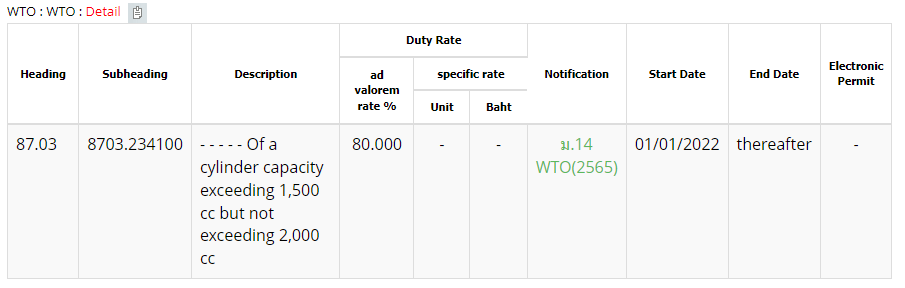
In the beginning, TOYOTA intended to export Automobiles to Thailand. In this case, the tariff rate for Automobiles(HS:8703.23) is 80%(see the image)
The duty rate of 80% is very high and there is no FTA preferential treatment between Thailand and Japan for Automobiles(HS:8703.23).
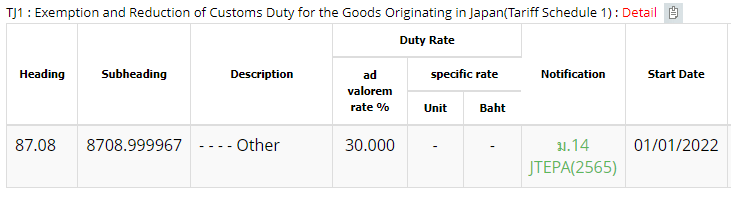
On the other hand, FTA between Thailand and Japan, there is preferential treatment for “Automobile parts” (HS:8708) 60% to 30%.
Toyota came up with an idea that they disassemble the Automobiles, ship them to Thailand and declare them as “Automobile parts”, and after clearance, they reassemble them to complete the car in Thailand.
If Toyota had exported Automobiles to Thailand, the duty rate would be 80% but if they disassemble them into Automobile parts, the duty rate would be 30%, literally, they succeeded to reduce 50% of customs duty.
It seemed it works, so they continued this Tariff Engineering from 2010 to 2012 for more than 20,000 vehicles assembled at Toyota’s Gateway factory.
But this is a double-edged strategy.
After that, Thailand customs pointed out that they are not Automobile parts because after importing those items to Thailand, they can be reassembled to be a complete automobile.
It’s nothing other than “Completely Knocked Down”, Thailand customs thought.
To understand why Automobile parts are regarded as complete automobiles by customs, we need to refer to the “General Rules of Interpretation (GRIs)”
GRI 2(a) states below
2. (a) Any reference in a heading to an article shall be taken to include a reference to that article incomplete or unfinished, provided that, as presented, the incomplete or unfinished article has the essential character of the complete or finished article.
It shall also be taken to include a reference to that article complete or finished (or falling to be classified as complete or finished by virtue of this Rule), presented unassembled or disassembled.
It means an unassembled or disassembled product is regarded as a completed product.
That’s the reason why Automobile parts are regarded as complete automobiles by Thailand customs.
The argument between Thailand customs and Toyota had taken a long time and it was brought to Court.
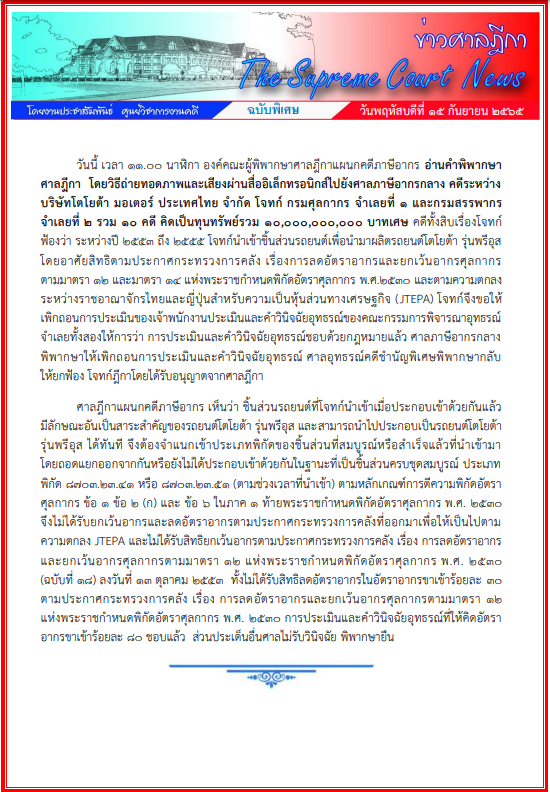
Sept 15, 2022 – Thailand Supreme Court on Thursday upheld a lower court ruling that the local unit of Toyota Motor Corp owed the government 10 billion baht ($272.11 million) in extra taxes for importing components not subject to a reduced tariff.
Below is translated judgment. (Sorry it’s hard to read due to machine translation.)
Today at 11:00 a.m., the Supreme Court of Justice Department of Tax Cases read the verdict. The Supreme Court means transmitting images and sounds via electronic media to the Central Tax Court.
Cases between Toyota Motor Thailand Company Limited, the plaintiff, the Customs Department, the 1st defendant, and the Revenue Department The 2nd defendant, a total of 10 cases, accounted for total assets of 10 million baht, In all ten cases, plaintiffs sued that between 2010 and 2012, the plaintiff imported the friend’s car parts used to produce Toyota Prius models by the notification of the Ministry of Finance Regarding the reduction of duty rates and the exemption of customs duties under Section 12 and Section 14 of the Royal Decree on Customs Tariffs B.E. between the Kingdom of Thailand and Japan For the Economic Partnership (JTEPA), the plaintiff asked.
revoke the assessment of the assessment and make an appeal decision of the Appeal Committee.
Both defendants testified that the assessment and The appeal ruling are lawful.
Central Tax Court adjudged to revoke the assessment and Appeal Court of Appeal The special judges returned.
to dismiss the plaintiff’s petition with permission from the Supreme Court The Supreme Court’s Tax Litigation Division found that the plaintiff’s car parts are to be imported when assembled having a material nature It is important for the Toyota Prius model and can be assembled into Toyota cars.
Prius immediately, so it must be classified into the coordinate type of the complete part or for the successfully imported either disassembled or not assembled as a complete set of parts.
Tariff 8703.23.41 or 8703.23.51(according to the time of import) according to the tariff interpretation rules Customs Clause 1, *Article 2 (a) and Article 6 in Part 1 annexed to the Royal Decree on Customs Tariffs, B.E. 2530 (1987)
*Guess it means GRI 2(a)
Therefore, it is not exempt from duty and reduces the duty rate according to the notification of the Ministry of Finance issued to comply with the JTEPA agreement and is not entitled to exemption from duty according to the Ministry of Finance’s notification regarding the reduction of duty rates and exemption of customs duties under Section 12 of the Royal Decree on Customs Tariffs, B.E. 2530 (No. 18) dated October 13, 2010, neither has the right to reduce the duty rate at the import duty rate of 30 percent.
under the Notification of the Ministry of Finance Re: Reduction of Duty Rates and Exemption of Customs Duty under Section 12 of the Royal Decree on Customs Tariffs, B.E. in the appellate decision to charge the rate 80% of the import duty was approved, while other issues were not accepted by the court, and the verdict was confirmed.
Sometimes I hear that “to reduce duty rate, disassemble the commodity into parts to import and reassemble them in the targeting country, Wow this is a smart way of Tariff Engineering”
But this is the inadequate solution for reducing the duty rate that most people easily come up with.
In short term, it might work I admit, but customs officers are not foolish in overlooking this behavior. Therefore it turned out to be a nightmare one day.
It does not mean disassembling the commodity into parts to import is not a bad way. Sometimes depending on the commodity, disassembling is required.
But please keep in mind that customs seek the possibility to adopt GRI 2(a) to disassembled commodity to reclassify to another HS code. Don’t underestimate GRI 2(a), it is very important.
If there is a need for disassembling commodities, I recommend consulting customs that the HS code is appropriate in a wide range of views.
As a Japanese, I am personally proud of Toyota’s international business. Hoping Toyota overcomes this incident and develops more. This incident must be a great guideline for many traders worldwide.
This post is written based on translated judgment. If I misunderstand the content, please let me know.
The Harmonized System (HS) is an internationally standardized system of names (description) and numbers (codes) for classifying traded goods.
The HS is a product nomenclature where each product is assigned its corresponding “6-digit” code.
It was developed and presently maintained by the World Customs Organization (WCO) (formerly known as the Customs Cooperation Council (CCC)) headquartered in Brussels, Belgium.
The HS nomenclature is annexed to the International Convention on the Harmonized Commodity Description and Coding System.
It was developed to facilitate international trade by establishing a uniform system for the collection, comparison and analysis of international trade statistics.
It was established in 1983 and entered into force in 1988.
Under this Convention, contracting parties are obligated to base their tariff schedules on the HS nomenclature, although parties set their own rates of duty.
Countries that have adopted the Harmonized System are not permitted to alter in any way the descriptions associated to a heading or a subheading nor can the numerical codes at the four or six digit levels be altered.
This is what keeps the Harmonized System harmonized.
Individual countries may extend a Harmonized System code to eight or ten digits for customs purposes.
More than 200 countries, customs and economic unions, representing more than 98% of world trade use the HS.
Primary uses of the Harmonized System
Determination of customs tariffs (import duty)
Collection of international trade statistics
Rules of origin
Ascertain eligibility of a product under a Free Trade Agreement
Compliance with customs requirements
Collection of government revenue
Trade negotiations (e.g. the WTO schedule of tariff concessions)
Here is an example of the structure of the harmonized system in Section 10(X)
Sections
– The HS is primarily divided into 21 Sections
Example
Section I: Live Animals; Animal Products
Section VII: Plastics and Articles Thereof Rubber and Articles Thereof
Section XV: Base Metals and Articles of Base Metal
Section XVII: Vehicles, Aircraft, Vessels and Associated Transport Equipment
*The titles of Sections, Chapters and Subchapters are not legally binding – They are for ease of reference only – They are “pointers” or “labels” used to divide up the nomenclature. – Help in directing you to areas of the nomenclature. – They should not be quoted to support classification.
Example: Section XV is entitled “base metal and articles of base metal” -However, many articles of base metal are classified in other Sections.
Chapters
– Sections are divided into Chapters – There are 99 Chapters under the HS – However, Chapter 77 is reserved for future use, while Chapters 98 & 99 are reserved for special uses by contracting parties to the HS Convention
• Goods under chapters 1 to 83 are generally classified according to material of manufacture. • Goods under chapter 84 to 96 are generally classified according to function
Headings
– Chapters are divided into headings – Headings are assigned with four-digit codes
– Headings are further divided into subheadings – HS subheadings are assigned with six-digit codes
For example, the HS code for Milled rice is 1006.30
Source: Trade Development Authority of Pakistan
The full HS code for Milled rice is
1006.30.xxxx
■The first two digits 10 The first two digits are referred to as the Chapter to which the product belongs. Here rice comes under chapter 10, which is ‘Cereals’.
■The first four digits 1006 The first four digits are referred to as the Heading. Here rice comes under Heading 1006, which is ‘Rice’.
■The first six digits 1006.30 The first six digits are referred to as the SubHeading. Here rice comes under SubHeading 1006.30, which is ‘Semi-milled or wholly milled rice, whether or not polished or glazed:’.
■The entire digits 1006.30.10xx The final 4 digits shown here in Green1006.30.xxxx are country-specific and are assigned by individual countries. Custom duties are assigned on entire codes, so without these last Green part digits determining the custom duty applicable on your products would not be possible.
How to classify HS code
In order to determine the HS code, we need to get a full and accurate description. Here are basic questions to ask in determining the identity of items:
• Where is it used? (LOCATION) • What material or substance is it made of? (MATERIAL) • What is its function or use? (FUNCTION) • In what form/spec is it imported? (SPECIFICATION) • Is this the only possible classification?
Example: Classify “HOOD ASSY”
– Location: Car Body – Material: Metal – Function: Car Hood
Therefore it belongs to… • Section XVII • Chapter 87 • Heading 8708 • Subheading 870829
Apply the Sections, Chapter and Subchapter Notes
A commodity can be classified either by: – Terms of the Heading – Notes to the Sections, Chapters or Subheadings – The General Interpretative Rules (GRI)
The Legal Notes which appear in front of most Sections and Chapters are known as Section Notes and Chapter Notes which has a legal force to determine HS code.
– For the purposes of this chapter, “tractors” means vehicles constructed essentially for hauling or pushing another vehicle, appliance or load, whether or not they contain subsidiary provision for the transport, in connection with the main use of the tractor, of tools, seeds,fertilizers or other goods.
– Machines and working tools designed for fitting to tractors of heading 8701 as interchangeable equipment remain classified in their respective headings even if presented with the tractor, and whether or not mounted on it.
– These notes establish the classification of certain goods. – Example: Note 4 to section XVII establishes the classification of “amphibious motor vehicles”
Note 4 to Section XVII For the purposes of this section: (b) Amphibious motor vehicles are classified under the appropriate heading of chapter 87;
For example, Notes 2, 3 and 4 to Chapter 31 together provide an exhaustive list the products that fall to be classified as fertilisers in headings 31.02, 31.03 and 31.04. In comparison, Note 3 to Chapter 86 specifies some of the railway and tramway track fixtures and fittings covered by heading 86.08.
Example of Limitations of Scope
– These notes limit the scope of goods to be classified in the section. – Example: Note 2 to section XVII (which limits the scope of the expressions “Parts” and “Parts and accessories”).
Note 2 to section XVII The expressions “parts” and “parts and accessories” do not apply to the following articles, whether or not they are identifiable as for the goods of this section:
The tariff classification of merchandise under the Harmonized System is governed by the principles set forth in the General Rules of Interpretation(“GRIs”).
The GRIs are intended to be consulted and applied each time merchandise is to be classified under the Harmonized System.
Accordingly, it is the GRIs that are the single set of legal principles that always govern the classification of merchandise under the Harmonized System.
There are six GRIs in all.
Things to remember
The application of the GIRs (1-4) should always be in SEQUENTIAL ORDER: Rule 1 is to be taken into consideration first. If classification is not covered by the provisions of Rule 1, then apply Rule 2, and so on.
Goods must first be classified in the 4-digit HS heading whose terms most specifically describe the goods (unless otherwise required or directed by the GIRs) and
Only 4-digit headings are comparable: Do not compare a heading description with a subheading description.
Example: Classification of an electric toothbrush.
Retrieved from: HARMONIZED COMMODITY DESCRIPTION and CODING SYSTEM or HARMONIZED SYSTEM(HS)
Heading 85.09 as an “Electro-mechanical domestic appliances with self-contained electric motor,….” OR Subheading 9603.21 which provides for “Toothbrushes,…”. (Heading 96.03 provides for “Brooms, brushes…”)
NO! Do not compare a heading description with a subheading description. It is important to know about things to remember before understanding GRIs.
An electric toothbrush could potentially be classified in heading 8509 as an electromechanical domestic appliance with self-contained motor and in heading 9603 as a brush. Within heading 9603, subheading 9603.21 provides for “toothbrushes.” No consideration should be given to this subheading when comparing the terms of the headings to determine the appropriate heading for classification of the electric toothbrush (as merchandise must first be classified in the Harmonized System at the heading level by the terms of the headings).
GRI Rule 1 Terms of the Headings, Section/Chapter Notes
THE TABLE OF CONTENTS, ALPHABETICAL INDEX, AND TITLES OF SECTIONS, CHAPTERS AND SUB-CHAPTERS ARE PROVIDED FOR EASE OF REFERENCE ONLY; FOR LEGAL PURPOSES, CLASSIFICATION SHALL BE DETERMINED ACCORDING TO THE TERMS OF THE HEADINGS AND ANY RELATIVE SECTION OR CHAPTER NOTES AND, PROVIDED SUCH HEADINGS OR NOTES DO NOT OTHERWISE REQUIRE, ACCORDING TO THE FOLLOWING PROVISIONS: [that is, GRIs 2 to 6].
In the GRI’s principles of HS classification, the very first rule states, “The titles of Sections, Chapters and sub‑Chapters are provided for ease of reference only.” This means that when classifying a specific product, the product’s name does not necessarily have to match the wording in the HS Tariff’s section, chapter, and sub‑chapter titles, as these titles do not have binding legal force.
For example, consider the following plastic warning sign.
Since it is made of plastic, one might be inclined to assume that it falls within
“Section VII: PLASTICS AND ARTICLES THEREOF; RUBBER AND ARTICLES THEREOF” and more specifically within “Chapter 39: Plastics and articles thereof.”
While this may seem natural, GRI1 clearly states that the titles are provided solely for reference, and therefore such assumptions can be incorrect.
In this case, although the product is made of plastic, the significance of the printed text led to its classification as a “printed material” rather than as a plastic product (EUBTI: DEBTI28270/21-1, HS: 4911.99).
This example illustrates how equating a product’s name with the wording of the HS Tariff titles can lead to misclassification. Please be cautious, as many parties misinterpret this provision and consequently apply an incorrect HS classification.
Here is another example that shows how the titles of sections and chapters are provided for ease of reference only.
This product is dental floss, but it’s quite difficult to find it by searching through the TITLES OF SECTIONS and CHAPTERS. This is because, in order to classify dental floss with legal authority, it is necessary to refer to the Headings. Please see the classification table below.
The description under Section VI, “PRODUCTS OF THE CHEMICAL OR ALLIED INDUSTRIES,” and the one under Chapter 33, “Essential oils and resinoids; perfumery, cosmetic or toilet preparations,” do not, by any means, clearly lead you to the classification of dental floss.
However, when you reach Heading 3306, you finally find the description: “Preparations for oral or dental hygiene, including denture fixative pastes and powders; yarn used to clean between the teeth (dental floss), in individual retail packages.”
This illustrates exactly why it is said that titles of sections and chapters are provided for ease of reference only.
Now that you understand the meaning of “The titles of Sections, Chapters and sub‑Chapters are provided for ease of reference only,” let’s move on to the next step.
GIR1 further states the following. “for legal purposes, classification shall be determined according to the terms of the headings and any relative Section or Chapter Notes and, provided such headings or Notes”
This means that “The titles of Sections, Chapters and sub‑Chapters” do not have legal binding force (ease of reference only), whereas “terms of the headings and any relative Section or Chapter Notes and, provided such headings or Notes” do have legal binding force.
Now, let’s take a look at the actual structure of the HS tariff.
Example of Terms of the Headings, Section/Chapter Notes
It contains both legally binding descriptions and non-binding ones. Be sure to understand the differences between them clearly. Therefore, marked the legally binding elements with blue circles and the non-binding ones with red circles.
CHAPTERS ARE PROVIDED FOR EASE OF REFERENCE ONLY; FOR LEGAL PURPOSES, CLASSIFICATION SHALL BE DETERMINED ACCORDING TO THE TERMS OF THE HEADINGS
CHAPTERS AND SUB-CHAPTERS (below “I.-” and “II.-“) PROVIDED FOR EASE OF REFERENCE ONLY; FOR LEGAL PURPOSES, CLASSIFICATION SHALL BE DETERMINED ACCORDING TO THE TERMS OF THE HEADINGS
When discussing HS classification with customs authorities, only the legally binding descriptions are used, while the others are for ease of reference only.
EXAMPLE 1: Under GRI 1, if a provision specifically and completely describes a product, then the product would be classified in that provision (e.g., fresh grapes are classified under heading 0806 which provides for “grapes, fresh or dried”). In this situation, the product is classified by the terms of a heading.
Example: Live poultry (heading 01.05)
Retrieved from: HARMONIZED COMMODITY DESCRIPTION and CODING SYSTEM or HARMONIZED SYSTEM(HS)
EXAMPLE 2: Note 3 to Section XVI to the Harmonized System directs classification of composite machines described therein on the basis of the “principal function” of the machines. Under GRI 1, such machines are to be classified as so directed in that note. In this situation, the products are classified by the terms of a section note.
EXAMPLE 3: Section XV is entitled “Base metals and articles of base metal” but jewelry of base metal is classified in Section XIV.
EXAMPLE 4: Chapter 61 is entitled “Articles of apparel and clothing accessories, knitted or crocheted”, although the chapter also covers certain articles which are not wholly knitted or crocheted, such as those in heading 62.12.
EXAMPLE 5: Cat toy At first glance, it might seem to fall under HS Code 9503 (toys), but that’s not the case! Toys for animals are excluded from HS Code 9503 as stated in Note 5 to Chapter 95, so they are classified based on their material. Therefore, it is classified as “textile articles” in 6307.90.
GRI 1 further states “do not otherwise require, according to the following provisions.” that means if the texts of the headings and of the notes cannot, by themselves, determine the appropriate heading for classification of merchandise, then classification is to be determined by the appropriate GRIs that follow GRI 1 (i.e., GRIs 2 to 6).
Rule 2 (a) Incomplete or unfinished; Unassembled or disassembled
RULE 2. (a) ANY REFERENCE IN A HEADING TO AN ARTICLE SHALL BE TAKEN TO INCLUDE A REFERENCE TO THAT ARTICLE INCOMPLETE OR UNFINISHED, PROVIDED THAT, AS ENTERED, THE INCOMPLETE OR UNFINISHED ARTICLE HAS THE ESSENTIAL CHARACTER OF THE COMPLETE OR FINISHED ARTICLE. IT SHALL ALSO INCLUDE A REFERENCE TO THAT ARTICLE COMPLETE OR FINISHED (OR FALLING TO BE CLASSIFIED AS COMPLETE OR FINISHED BY VIRTUE OF THIS RULE), ENTERED UNASSEMBLED OR DISASSEMBLED.
GRI 2 (a) has two parts. Part one deals with incomplete or unfinished goods and part two deals with unassembled or disassembled goods.
Part One incomplete or unfinished goods
The first part of GRI 2 (a) extends the scope of any heading that refers to a particular article to cover not only the complete article but also that article incomplete or unfinished, provided that, as presented, it has the “essential character” (which is discussed below) of the complete or finished article.
EXAMPLE1: A ceramic statuette of the Hokie Bird that will be painted after importation would still generally have the essential character of a ceramic statuette of heading 6913 (i.e., one would still recognize and identify the product as a ceramic statuette) and would, therefore, be classified pursuant to GRI 2 (a) as the finished product in heading 6913.
Retrieved from: HARMONIZED COMMODITY DESCRIPTION and CODING SYSTEM or HARMONIZED SYSTEM(HS)
Example3: A car without wheels, is considered as a complete car.
Part Two unassembled or disassembled goods
The second part of GRI 2 (a) provides that complete or finished articles presented unassembled or disassembled (which may occur for reasons related to the packing, handling or transportation of the articles) are to be classified in the same heading as the assembled article. It also provides incomplete or unfinished articles presented unassembled or disassembled are to be classified in the same heading as the complete or finished article provided that as presented they have the essential character of the complete or finished article (as provided for in the first part of GRI 2 (a)).
EXAMPLE1: A shipment of an unassembled bicycle (containing all parts and components necessary to build a bicycle) would be classified in heading 8712 as an assembled, finished bicycle as if it were entered (or imported) as the assembled, finished bicycle.
Example2: A complete set of wooden panels meant for assembly into a cupboard, is considered as a finished cupboard.
Retrieved from: HARMONIZED COMMODITY DESCRIPTION and CODING SYSTEM or HARMONIZED SYSTEM(HS)
Rule 2 (b) Mixtures or combinations
RULE 2.(b) ANY REFERENCE IN A HEADING TO A MATERIAL OR SUBSTANCE SHALL BE TAKEN TO INCLUDE A REFERENCE TO MIXTURES OR COMBINATIONS OF THAT MATERIAL OR SUBSTANCE WITH OTHER MATERIALS OR SUBSTANCES. ANY REFERENCE TO GOODS OF A GIVEN MATERIAL OR SUBSTANCE SHALL BE TAKEN TO INCLUDE A REFERENCE TO GOODS CONSISTING WHOLLY OR PARTLY OF SUCH MATERIAL OR SUBSTANCE. THE CLASSIFICATION OF GOODS CONSISTING OF MORE THAN ONE MATERIAL OR SUBSTANCE SHALL BE ACCORDING TO THE PRINCIPLES OF RULE 3.
GRI 2 (b) governs the classification (1) of mixtures and combinations of materials or substances and (2) of goods consisting of two or more materials or substances. The rule extends headings referring (1) to a material or substance to include mixtures or combinations of that material or substance with other materials or substances and (2) to goods of a given material or substance to include goods consisting wholly or partly of that material or substance (but only as long as another heading does not refer to the goods in their mixed or composite state).
If the addition of another material or substance deprives the imported good of the character of the kind mentioned in the heading under consideration, however, then one must resort to GRI 3 for classification of the merchandise. Or, in other words, mixtures and combinations of materials or substances, and goods consisting of more than one material or substance, if upon initial consideration are potentially classifiable under two or more headings, they must be classified according to the principles of GRI 3.
EXAMPLE1: Under GRI 2 (b), a stainless steel travel mug with a plastic handle would be classifiable in heading 7323 as a table, kitchen or other household article of steel despite the plastic handle (as it retains the character of a table, kitchen or another household article of steel as mentioned in heading 7323). If a travel mug, however, contained relatively equal amounts of stainless steel and plastic (e.g., the outside or outer surface of the mug is made of plastic and the inside or inner surface (lining) of the mug is made of stainless steel), then the travel mug would be potentially classifiable under two headings: heading 3924 as tableware, kitchenware or other household article of plastic and heading 7323 as a table, kitchen or other household article of steel. (Or, contrasting this product with the initial one considered in this example, a travel mug consisting of relatively equal amounts of stainless steel and plastic does not have the character of a table, kitchen or other household article of steel as mentioned in heading 7323.) In this situation, pursuant to GRI 2(b), resort would need to be made to GRI 3 for classification of the product.
EXAMPLE2: Milk to which vitamins or minerals have been added.
EXAMPLE3: A pack of cornflakes which also contains a small amount of nuts and raisins.
Rule 3 Two or more headings
WHEN, BY APPLICATION OF RULE 2(b) OR FOR ANY OTHER REASON, GOODS ARE, PRIMA FACIE, CLASSIFIABLE UNDER TWO OR MORE HEADINGS, CLASSIFICATION SHALL BE EFFECTED AS FOLLOWS:
GRI 3 provides for the classification of goods that are prima facie (or when initially considered) classifiable under two or more headings. In such instances, the goods are classified pursuant to this rule based on three criteria, taken in order:
Rule 3 (a) Most specific
The heading which provides the most specific description shall be preferred to headings providing a more general description. However, when two or more headings each refer to part only of the materials or substances contained in mixed or composite goods or to part only of the items in a set put up for retail sale, those headings are to be regarded as equally specific in relation to those goods, even if one of them gives a more complete or precise description of the goods.
The first sentence to GRI 3 (a) provides that goods should be classified in the heading that provides the most specific description. In general, under this criterion, (1) a description by name is more specific than a description by class and (2) a description that more clearly identifies a product is more specific than one which is less complete.
Example1: Chair/ladder A wooden ladder is classified as “Other articles of wood(HS4421)” A wooden chair is classified as “Wooden chair(HS9401)” So where to be classified??
Retrieved from: HARMONIZED COMMODITY DESCRIPTION and CODING SYSTEM or HARMONIZED SYSTEM(HS)
Relative Specificity A description by name is more specific than a description by class. A description that more clearly identifies a product is more specific than one which is less complete.
the name “Wooden chair” more clearly identifies than “Other articles of wood” Therefore this product is classified as Wooden chair(HS9401)
Example2: Steel spoon is classified in HS82.15(Spoons) and not in HS73.23(Steel Household)
Example3: Seats for motor vehicles are classified in HS94.01(Seats for motor vehicles) and not in HS 87.08(Parts and accessories of the motor vehicles)
Example4: An example of a description by name in one heading that is more specific than a description by class in another heading is as follow: “shavers and hair clippers with self-contained electric motor” of heading 8510 is more specific than “electro-mechanical tools for working in the hand with self-contained electric motor” of heading 8467 or “electromechanical domestic appliances with self-contained electric motor” of heading 8509.
Example5: An example of a description in one heading that more clearly identifies a product than a description in another heading (and thus the first description is more specific than the second description) is as follows: A product identified as “unframed safety glass made of toughened or laminated glass that is shaped and identifiable for use in airplanes” is more clearly described by the article description “safety glass” of heading 7007 than by the article description “parts of goods of heading 8801 or 8802” (parts of aircraft and spacecraft) of heading 8803.
The second sentence to GRI 3 (a) further provides that when two or more headings each refer to only one of the materials or substances in mixed or composite goods, or to only some of the articles included in a set put up for retail sale, those headings are to be regarded as equally specific in relation to those goods, even if one of them gives a more complete or precise description of the goods. If this situation exists, then resort must be made to GRI 3 (b). (See examples discussed below for GRI 3 (b).)
Rule 3 (b) Essential character
Mixtures, composite goods consisting of different materials or made up of different components, and goods put up in sets for retail sale, which cannot be classified by reference to 3 (a), shall be classified as if they consisted of the material or component which gives them their essential character, insofar as this criterion is applicable.
GRI 3 (b) deals with mixed goods, composite goods, and goods put up in sets for retail sale as described above in the second sentence to GRI 3 (a) (i.e., each of the goods is potentially classifiable in more than one heading because each good consists of two or more different ingredients, materials, components or articles and no heading provides for the goods as a whole).
By application of this criterion, such goods are classified according to the ingredient, material, component or article that gives the mixtures, composite goods, or sets their “essential character.”
Goods Put up in Sets for Retail Sale. For the purposes of GRI 3 (b), the term “goods put up in sets for retail sale” means that the goods under consideration must (a) consist of at least two different articles (i.e., the articles must be of a different type or nature, e.g., two table spoons are not such a “set”) which are, prima facie, classifiable in different headings; (b) consist of products or articles put up together to meet a particular need or carry out a specific activity; and (c) are put up in a manner suitable for sale directly to users without repacking.
Example1:Mixture of barley (60%) of HS10.03 and oats (40%) of HS10.04
Retrieved from: HARMONIZED COMMODITY DESCRIPTION and CODING SYSTEM or HARMONIZED SYSTEM(HS)
An example of a mixture of barley of HS1003(60%) and oats of HS1004(40%) in different amounts. In such an instance, “barley” gives their essential character. Therefore the mixture is classified as “barley(HS1003)”
Example2: smart glass
These smart glasses are classified using the same logic applied to wearable devices such as smartwatches.
Breakdown of functions and candidate headings:
Function as sunglasses 👉 Heading 90.04 (spectacles, goggles and the like, corrective, protective or other)
Photo and video recording (camera) 👉 Heading 85.25 (digital cameras and video camera recorders)
Communication functions such as calls and message transmission (Bluetooth, Wi-Fi, microphone, speaker) 👉 Heading 85.17 (other telecommunication apparatus)
Classification logic (application of GRI 3(b)): As stated in the description, without connection to a smartphone, the device functions merely as ordinary glasses. In other words, the product’s added value lies in its ability to communicate with a smartphone (the host device) to perform calls and exchange data.
Therefore, under GRI 3(b), it is reasonable to determine that the wireless communication function gives the product its essential character.
Comparable cases (wearable devices): The classification examples in the source include several cases of smartwatches (battery-powered wearable devices) that connect to a host device via Bluetooth or similar technologies, enabling calls, message transmission, and music playback control. All of these examples are classified under 8517.62.
These smart glasses differ from smartwatches only in the body part on which they are worn (face instead of wrist). Since their essential role is the same as communication-enabled wearable devices such as smartwatches, they are classified under HS heading 8517.62. HRBTIOM-2025-0027
Example3: An example of a “set” coming within the purview of GRI 3 (b) would be a hairdressing kit consisting of a pair of electric hair clippers of heading 8510, a comb of heading 9615, a pair of scissors of heading 8213, and a brush of heading 9603. In such an instance, there is a product that consists of more than one item or article with each article having a provision in which it could potentially be classified and no provision exists in the Harmonized System that provides for the set as a whole. In the above-mentioned hairdressing kit, the articles are put up together to meet the particular need or carry out the specific activity of grooming hair.
Retrieved from: HARMONIZED COMMODITY DESCRIPTION and CODING SYSTEM or HARMONIZED SYSTEM(HS)
Example4: A mixture for brewing, consisting of 70 % wheat and 30 % barley. The mixture is classified in Heading 10.01 (Wheat and meslin).
Example5: Liquor-filled chocolates are classified in Heading 18.06 (Chocolate and other food preparations containing cocoa).
Example6: A bed linen set comprising a woven bedspread, pillow-cases and bolsters put up in a paperboard case. It is classified in Heading 63.04.
In each of the above-mentioned example 4 to 6, one would need to make a determination as to the ingredient, material, component or article that imparts the essential character to the particular good. The good would then be classified as if made or consisting entirely of that ingredient, material, component or article. In some situations, however, no ingredient, material, component or article will be found to impart the essential character to a particular good. In such instances, resort would need to be made to GRI 3 (c) in order to classify the good.
Rule 3 (c) Last in numerical order
WHEN GOODS CANNOT BE CLASSIFIED BY REFERENCE TO 3(a) OR 3(b), THEY SHALL BE CLASSIFIED UNDER THE HEADING WHICH OCCURS LAST IN NUMERICAL ORDER AMONG THOSE WHICH EQUALLY MERIT CONSIDERATION.
GRI 3 (c) states that goods should be classified under the heading that occurs last in numerical order from among those that equally merit consideration if the goods cannot be classified by reference to GRIs 3 (a) or 3 (b).
EXAMPLE1:
Retrieved from: HARMONIZED COMMODITY DESCRIPTION and CODING SYSTEM or HARMONIZED SYSTEM(HS)
In the above-mentioned example of the mixed good consisting of barley and oats in equal amounts, if neither the barley nor the oats is found to impart the essential character to the product, then by application of GRI 3 (c) the product would be classified in heading 1004 as if consisting solely of the oats. This is because the heading number for the oats found in the mixture occurs last in numerical order as between it and the barley (i.e., 1003 for the barley and 1004 for the oats).
EXAMPLE2: TabletPC with Shopping Cart
Both of these items feature a tablet PC, yet they are classified under different HS codes.
Let’s look at Item 1, the typical tablet PC we use every day. Classification: 8471.30 (Automatic data processing machines, weighing not more than 10 kg). This is exactly what anyone would expect for a piece of modern high-tech equipment.
Now, consider Item 2, a so-called “Smart Shopping Cart” equipped with a similar touch-panel PC. Despite having a built-in tablet, this item was classified under 8716.80 (Other vehicles, not self-propelled).
Why “8716 (Carts)”? Why is a sophisticated assembly of expensive IT equipment treated as a mere “handcart”?
This is where the rule for composite goods, GRI 3(b), comes into play. This smart cart is a composite product consisting of elements from Chapter 84 (the PC) and Chapter 87 (the cart). According to GRI 3(b), when a product is made of different components, it must be classified based on which component gives the item its “Essential Character.”
The Customs’ determination was as follows: “The primary purpose of this product is to collect and transport goods to the checkout counter. The PC and scanner are merely auxiliary tools. Therefore, the essential character lies in the vehicle (cart).”
These two cases illustrate a fundamental philosophy of HS classification: “What it essentially is” takes precedence over “What it can do.”
Standalone Tablet PC: Since the device itself is the end goal (data processing), it is classified under 8471. Smart Cart: Since the goal is transportation and the PC is simply a means to facilitate it, it is classified under 8716. — Chapter 84,GENERAL(E) MACHINES INCORPORATING OR WORKING IN CONJUNCTION WITH AN AUTOMATIC DATA PROCESSING MACHINE AND PERFORMING A SPECIFIC FUNCTION (Chapter Note 6 (E)) Machines incorporating or working in conjunction with an automatic data processing machine and performing a specific function other than data processing are to be classified in the headings appropriate to their respective functions or, failing that, in residual headings. — EUBTI(invalidated) US CROSS(similer case)
EXAMPLE3: Smart Ring
This smart ring is a composite device (multi-component device) that incorporates several different functions, and its classification follows a typical method based on the General Rules for the Interpretation (GRIs).
Breakdown of functions and candidate headings: According to the description, the ring includes the following functions:
Measurement of heart rate and oxygen saturation (PPG sensor) 👉 Heading 90.18 (medical instruments for examining physiological parameters)
Measurement of body temperature (temperature sensor) 👉 Heading 90.25 (thermometers)
Data transmission to a smartphone (Bluetooth) 👉 Heading 85.17 (telecommunication apparatus)
Classification logic (application of GRI 3(c)): This device performs multiple roles, including measurement and monitoring of biometric information and data transmission. However, as stated in Description 2 of the BTI, none of these functions can be clearly determined to be the principal (primary) function of the device.
In such cases—where an article can fall under multiple headings and no single heading can be identified as the most important—GRI 3(c) applies. Under this rule, the product is classified in the heading that occurs last in numerical order among those that equally merit consideration.
Among the possible headings 85.17, 90.18, 90.25, and 90.29, the heading that appears last in numerical order is 90.31 (measuring or checking instruments, appliances and machines, not specified elsewhere). Therefore, the product was classified under heading 90.31. PLBTIWIT-2025-000576
EXAMPLE4: A belt made of 50 % leather(heading42.03) and 50 % textiles(heading62.17) is classified in Heading 62.17.
EXAMPLE5: A machine-tool for working stone(heading 84.64) as well as wood(heading 84.65) is classified in Heading 84.65.
EXAMPLE6: Electric lamp (heading 94.05) with an alarm clock (heading 91.05) is classified in 94.05.
EXAMPLE7: Chandeliers (heading 94.05) with electric fan (heading 84.14) is classified in 94.05.
WHAT IS THE ESSENTIAL CHARACTER OF A PRODUCT? The term “essential character,” as used in the GRIs, is not defined in the Harmonized System. As concerns that term, however, it is stated in the Explanatory Notes to the Harmonized System (which is an extrinsic interpretative aid to the Harmonized System that is discussed below) that the factor that determines the essential character of a good will vary as between different kinds of goods (i.e., essential character must be determined on a case-by-case basis). The essential character of a good, may, for example, be determined by the nature of the material or component, its bulk, quality, weight or value, or by the role of a constituent material in relation to the use of the goods. Other factors may be considered in determining the essential character of a product.
Rule 4 Most akin
GOODS WHICH CANNOT BE CLASSIFIED IN ACCORDANCE WITH THE ABOVE RULES SHALL BE CLASSIFIED UNDER THE HEADING APPROPRIATE TO THE GOODS TO WHICH THEY ARE MOST AKIN.
If goods cannot be classified according to GRIs 1 to 3, then resort must be made to GRI 4. GRI 4 requires that goods are to “be classified under the heading appropriate to the goods to which they are most akin.” This rule should be applied very infrequently as GRIs 1 to 3 will cover the classification of almost all goods. When attempting to apply this rule, however, any determination regarding “kinship” should depend on such factors as description, character, purpose or intended use, designation, production process and the nature of the goods.
EXAMPLE1: Exhaust Air Jack (heading 84.25)
Retrieved from: HARMONIZED COMMODITY DESCRIPTION and CODING SYSTEM or HARMONIZED SYSTEM(HS)
EXAMPLE2:Carbonized Corn Cobs
Retrieved from:Japan Customs
Description: Carbonized corn cobs used as a soil conditioner
Composition: 80% carbon, 20% moisture
Form: Lumps of approximately 1–3 cm
Packaging: 10 kg per plastic bag
According to Heading 44.02 of the tariff schedule, charcoal includes vegetable-based shells and nut charcoal, but does not explicitly mention charcoal made from corn cobs.
Corn cobs are indeed plant-based, but they are structurally different from nut shells or seed husks. Unlike nut shells, which have a hard outer covering, corn cobs have a softer, more fibrous structure. Therefore, there is room for interpretation as to whether they strictly fall under the “vegetable-based shells” intended by HS 4402.
However, given that its manufacturing process, characteristics, and usage are similar to those of wood charcoal, GRI 4 is applied. Under this rule, the product is classified under Heading 44.02, which covers the most similar goods.
Rule 5 Containers
IN ADDITION TO THE FOREGOING PROVISIONS, THE FOLLOWING RULES SHALL APPLY IN RESPECT OF THE GOODS REFERRED TO THEREIN:
GRI 5 has two sections: GRI 5 (a) and GRI 5 (b). These two sections deal with various types of containers presented with the articles for which they are intended.
Rule 5 (a) Special containers
(a) CAMERA CASES, MUSICAL INSTRUMENT CASES, GUN CASES, DRAWING INSTRUMENT CASES, NECKLACE CASES AND SIMILAR CONTAINERS, SPECIALLY SHAPED OR FITTED TO CONTAIN A SPECIFIC ARTICLE OR SET OF ARTICLES, SUITABLE FOR LONGTERM USE AND ENTERED WITH THE ARTICLES FOR WHICH THEY ARE INTENDED, SHALL BE CLASSIFIED WITH SUCH ARTICLES WHEN OF A KIND NORMALLY SOLD THEREWITH. THIS RULE DOES NOT, HOWEVER, APPLY TO CONTAINERS WHICH GIVE THE WHOLE ITS ESSENTIAL CHARACTER;
GRI 5 (a) deals with the treatment of long-term use cases, boxes, and similar containers presented with the articles for which they are intended. Under this rule, long-term use containers imported with articles for which they are intended to be used are to be classified with the articles if they are of a kind of container normally sold with such articles (e.g., camera cases with cameras and musical instrument cases with musical instruments). This rule, however, does not apply to containers that give the imported article its essential character (e.g., a silver tray or dish containing tea or a high-quality ornamental ceramic bowl containing candies or sweets). Such merchandise is to be classified under the heading for the container.
EXAMPLE1: Violin(HS9202) with case(4202)
Retrieved from: HARMONIZED COMMODITY DESCRIPTION and CODING SYSTEM or HARMONIZED SYSTEM(HS)
Packing materials and packing containers entered with the goods therein shall be classified with the goods if they are of a kind normally used for packing such goods.
Violin with a case would be classified as Violin(HS9202) if the items satisfie Rule 5(a).
It seems that it satisfies Rule 5(a) but in this situation Gumball and toy packaging should be classified separately because of Rule 5(a) states that, THIS RULE DOES NOT, HOWEVER, APPLY TO CONTAINERS WHICH GIVE THE WHOLE ITS ESSENTIAL CHARACTER;
Toy packaging gives the whole it’s an essential character. Therefore Gumballs are classified HS1704 The toy packaging is classified HS9503 as Toy.
Rule 5 (b) Packing materials & containers
(b) SUBJECT TO THE PROVISIONS OF RULE 5(a) ABOVE, PACKING MATERIALS AND PACKING CONTAINERS ENTERED WITH THE GOODS THEREIN SHALL BE CLASSIFIED WITH THE GOODS IF THEY ARE OF A KIND NORMALLY USED FOR PACKING SUCH GOODS. HOWEVER, THIS PROVISION IS NOT BINDING WHEN SUCH PACKING MATERIALS OR PACKING CONTAINERS ARE CLEARLY SUITABLE FOR REPETITIVE USE.
GRI 5 (b) states that packaging containers and materials not normally intended to be reused are classified with the articles in which they are presented or imported (e.g., cardboard boxes or containers containing food products). This rule, however, does not apply to packaging materials or packing containers clearly suitable for repetitive use (e.g., certain metal drums or containers of iron or steel for compressed or liquefied gas). Such containers are to be classified separately from the materials that they hold.
Example1: Men’s shirts individually sealed in a polybag then packed in cardboard boxes
Retrieved from: HARMONIZED COMMODITY DESCRIPTION and CODING SYSTEM or HARMONIZED SYSTEM(HS)
In this situation, Men’s shirts with the cardboard box are entirely classified as shirts.
EXAMPLE2: Gumball dispensing machine
Gumball dispensing machine (predominantly of zinc alloy) imported with gumballs. It is designed to accept a coin and release a candy.
It seems that it satisfies Rule 5(b), but in this situation Gumball and dispensing machine should be classified separately because of Rule 5(b) states that, HOWEVER, THIS PROVISION IS NOT BINDING WHEN SUCH PACKING MATERIALS OR PACKING CONTAINERS ARE CLEARLY SUITABLE FOR REPETITIVE USE.
Dispensing machine is considered as a container which suitable for repetitive use. Therefore Gumballs are classified HS1704 The dispenser is classified HS7907.
Rule 6 Subheading rule
For legal purposes, the classification of goods in the subheadings of a heading shall be determined according to the terms of those subheadings and any related Subheading Notes and, mutatis mutandis, to the above Rules, on the understanding that only subheadings at the same level are comparable. For the purposes of this Rule the relative Section and Chapter Notes also apply, unless the context otherwise requires.
GRI 6 is the last of the GRIs. It prescribes that, for legal purposes, GRIs 1 to 5 govern, mutatis mutandis (or with the necessary changes), classification at subheading levels within the same heading. Or, in other words, GRIs 1 to 5 are to be reapplied to determine the classification of goods at the subheading level. Goods are to be classified at equal subheading levels (that is, at the same digit level) within the same heading under the subheading that most specifically describes or identifies them (or as otherwise required or directed under GRIs 1 to 5). Only subheadings at the same level within the same heading are comparable (i.e., no consideration should be given to the terms of any subheading within another subheading when considering the proper classification of merchandise at the higher level subheading).
EXAMPLE 1: A framed glass mirror is found to be classified in heading 7009. Thereafter, it would have to be classified within the subheading structure of that heading by application of GRIs 1 to 5 pursuant to GRI 6:
Initially, a determination would need to be made as to whether the framed glass mirror is classified at the 5-digit (or “one-dash”) subheading level in 5-digit subheading 7009.1 (“rear-view mirrors for vehicles”) or in 5-digit subheading 7009.9 (“other”). If the product is found to be classified in 5- digit subheading 7009.1 (as a rear-view mirror for a vehicle), then the classification analysis would end there and the product would be classified in subheading 7009.10 (as 5-digit subheading 7009.1 is not further subdivided). In the instant case, the framed glass mirror does not satisfy the article description for 5-digit subheading 7009.1. Therefore, the product would be classified at the 5-digit subheading level in 5-digit subheading 7009.9 (as a glass mirror other than a rear-view mirror for a vehicle). Next, a determination would have to be made as to whether the product is classified at the 6-digit (or “two-dash”) subheading level within 5-digit subheading 7009.9 in 6-digit subheading 7009.91 (as an unframed glass mirror other than a rear-view mirror for a vehicle) or in 6-digit subheading 7009.92 (as a framed glass mirror other than a rear-view mirror for a vehicle). The framed glass mirror would be classified in subheading 7009.92 by application of GRI 1 pursuant to GRI 6.
EXAMPLE 2: A set consisting of a shovel, fork, and pick for use in gardening would be classified in heading 8201 as each article is specifically provided for in the terms to that heading. Within heading 8201, shovels are provided for in subheading 8201.10, forks in subheading 8201.20, and picks in subheading 8201.30. Consequently, one would need to resort to GRI 3 pursuant to GRI 6 in order to classify the set at the subheading level within heading 8201. That is, one would need to determine which of the three articles imparts the essential character to the set pursuant to GRI 3 (b). If no one article is found to impart the essential character to the set, then one would classify the set under subheading 8201.30 because the subheading number for that article occurs last in numerical order as provided for in GRI 3 (c).
As evident from the above discussion, the GRIs provide that goods must first be classified by heading level, and only after the appropriate heading has been determined, then by equal subheading levels (first by five-digit and then by six-digit international levels) within that heading. When considering the appropriate classification at a particular subheading level, no consideration should be given to any of the terms of any lower-level subheading (as the analysis at each subheading level should be conducted without consideration of the terms of any lower-level subheading provision). This step-by-step analysis applies without exception throughout the Harmonized System (and throughout any national subheading levels as found in a particular country’s Harmonized System-based tariff system).